• Skip to primary navigation
  • Skip to main content
  • Skip to footer

Joe McMurray Music

Music for any occasion

  • Music
  • Services
  • Lessons
  • Bio
  • eBooks
  • Guitar Books the Podcast
  • Merch
  • Join the List
  • Weddings
  • Booking / Merch Order Form

Travis Style

Review #32: The Devil Is In It by John Stubbings

July 7, 2026 by joemcmurray Leave a Comment

https://media.blubrry.com/music_books/content.blubrry.com/music_books/Guitar_Books_Ep_32_Devil_Is_In_It_2026_07_05.mp3

Podcast: Play in new window | Download (Duration: 30:27 — 41.9MB) | Embed

Subscribe: Apple Podcasts | RSS | More

“The Devil Is In It” by John Stubbings is an incredible historical look at the acoustic guitar: its players, its builders, and how it is woven into the history of the United States and Europe.  This is an extremely valuable read for guitarists of all stripes.

  • You will learn about the evolution of the acoustic guitar from its earliest forms through to modern luthier-built masterpieces. 
  • You will hear the stories behind many famous and not-so-famous guitar builders and how they tie into the greater history of society.  
  • You will learn about the musical movements of the past several hundred years, and in doing so you will make new musical connections and you will fill gaps in your musical knowledge. 
  • You will undoubtedly be inspired to play and learn more guitar.

This is good stuff to know.

I’m honored to sit down today with the author himself.  Welcome, John Stubbings!

Note: The University of Texas Press sent me the book for free.

My own books:

Fingerstyle Blues Guitar: An In-Depth Study of the 12-Bar Blues in E Major – Books 1 and 2 are available in paperback or eBook through Amazon [https://a.co/d/g7Udsso (Book 1) and https://a.co/d/aDbh4H0 (Book 2)]. The first priority of these books is to quickly get you playing a solo instrumental 12-bar blues, & then to build on it until you can freely improvise or “jam.” You should be up and running by the end of the third chapter, and each following chapter will add icing on the cake.

Arranging for Fingerstyle Guitar: go to http://joemcmurray.com/checkout/ to purchase a pdf of my eBook.

Arranging for Fingerstyle Ukulele, will be published by Mel Bay in 2026.

My music is available on all streaming platforms at https://open.spotify.com/artist/5dcokTG6C598OhTslHH5uo?si=hrQb7FViSZewDRSgECw9Ew:

Pins on the Map: my third fingerstyle guitar album was released on January 19, 2024. Watch the first single, “Open Road,” on YouTube here: https://youtu.be/uPBh8sZQsT4?si=EM_wAwnHFqU1VC9C.

Riding the Wave and Acoustic Oasis: my first two fingerstyle guitar albums.

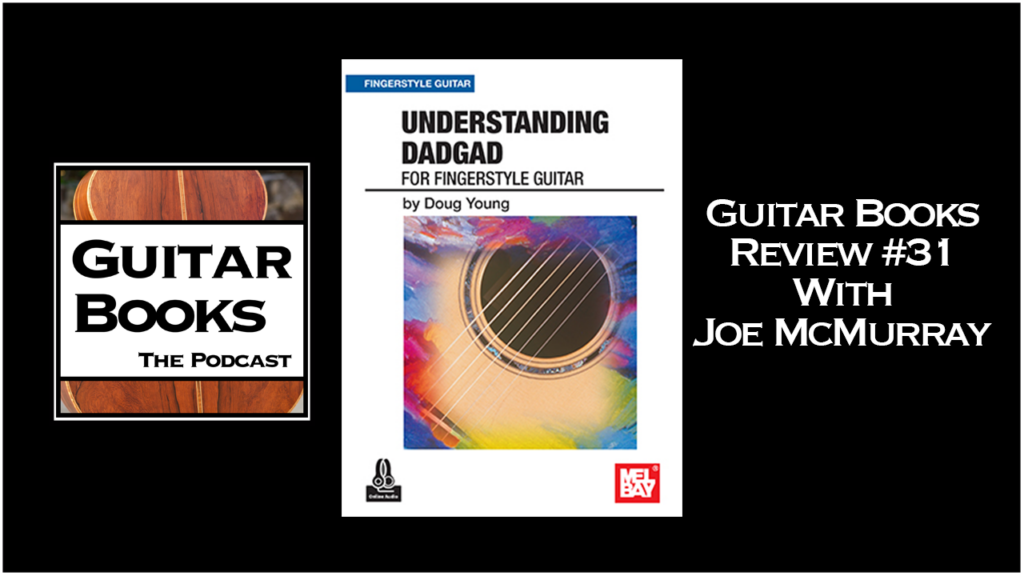
Review #31: Understanding DADGAD by Doug Young

May 14, 2026 by joemcmurray Leave a Comment

https://media.blubrry.com/music_books/content.blubrry.com/music_books/Guitar_Books_Ep_31_Understanding_DADGAD_2026_05_05.mp3

Podcast: Play in new window | Download (Duration: 25:56 — 35.8MB) | Embed

Subscribe: Apple Podcasts | RSS | More

Is this one of the best or worst method or repertoire books for learning to play acoustic fingerstyle blues guitar?

You can learn to play music using a variety of resources including teachers, online resources, and books.

Understanding DADGAD for Fingerstyle Guitar is a method book for… learning to play fingerstyle guitar using the wonderous alternate tuning known as DADGAD tuning.  This tuning is often associated with Celtic fingerstyle (Pierre Bensusan and Tony McManus), the British folk revival of the 1960s (Davy Graham), and modern fingerstyle (Andy McKee), but it truly excels in any genre.  

So, if you have some fingerstyle or classical guitar experience and you have an interest in beginning to utilize DADGAD tuning, this book will provide a comprehensive introduction.  Be aware, it is appropriate for intermediate to advanced fingerstyle guitarists.  Do not try to work through this book if you are just starting out with acoustic fingerstyle guitar – you really need to have the basics down before starting in this book.

Understanding DADGAD covers a lot of ground with regards to this alternate tuning, starting out by showing you simple chords, the basics of fretboard navigation, a few easier arrangements, and some accessible ideas for improvisation.  The book provides useful insights into how to leverage your knowledge of standard tuning to facilitate your learning of DADGAD – your 3rd, 4th and 5th strings are tuned the same as in standard tuning, while your 1st, 2nd, and 6th strings are tuned exactly one whole step down.  The book also does a great job introducing you to many of DADGAD’s unique characteristics – the tuning is especially well-suited to the harp-like cross-string technique, the use of drones, and the use of octaves paired with hammer-ons, pull-offs, and slides.

Where the book falls a little flat is that it doesn’t effectively show you how to arrange a tune in DADGAD tuning.  Upon completion of the book, you may have a few cool DADGAD tunes that you can play, but you may not know how to apply your newly acquired familiarity with the tuning to other music.  Personally, I am always arranging tunes for fingerstyle guitar, and while some tunes work great in standard tuning or drop-D, others seem to shine in DADGAD.  I recently arranged the Guns ‘N Roses hit, “Sweet Child of Mine,” to beef up my set-list for bars and breweries, and I started out arranging the tune in standard tuning.  It wasn’t sitting right in the original key, so I transposed it a couple times, but still didn’t like the results.  Finally, I arranged it in DADGAD and voila, the result was lush, musically satisfying, and playable/performable.  Here’s a sample of that arrangement.

My recommendation is that all fingerstyle players learn to arrange tunes in standard tuning, drop-D, and DADGAD.  While Understanding DADGAD doesn’t cover this topic, it does give you lots of tools (intervals, cross-string technique, etc.) to use in any future DADGAD arranging.  In my eBook, Arranging for Fingerstyle Guitar, I show you how to arrange Twinkle, Twinkle, Little Star in multiple keys in standard and alternate tunings (including DADGAD).  You can also check out my video/podcast series: Arranging Melodies for Fingerstyle Guitar, in which I show you how to arrange examples from the Essential Elements Guitar Method.  I’ll put a link to these videos in the corner and in the show description.

A nice supplement to Understanding DADGAD would be another book from our author: A DADGAD Christmas, again, also by Doug Young.  This other book contains great DADGAD arrangements of Christmas carols that you can both play and analyze to gain arranging insights.

Understanding DADGAD provides both treble clef and tablature for each arrangement.  Unfortunately, no fingerings are provided in the music.  For each example, I notated my own fingering in the music, after which I was able to play much more smoothly, accurately, and confidently.  The skill of choosing sensible fingering is important, and you will need to look elsewhere to further develop this skill.

Recordings are available online through Mel Bay’s website.  These will be very helpful to many readers.

© 2008 by Mel Bay

My own books:

Arranging for Fingerstyle Guitar: go to http://joemcmurray.com/checkout/ to purchase a pdf of my eBook.  Learning to arrange melodies will also help your fingerstyle songwriting and your understanding of the inner workings of fingerstyle guitar.

Fingerstyle Blues Guitar: An In-Depth Study of the 12-Bar Blues in E Major – Books 1 and 2 are available in paperback or as an eBook through Amazon [https://a.co/d/g7Udsso (Book 1) and https://a.co/d/aDbh4H0 (Book 2)].  The first priority of these books is to quickly get you playing a solo instrumental 12-bar blues, and then to build on it until you can freely improvise or “jam.” You should be up and running by the end of the third chapter, and each following chapter will add icing on the cake.  There is an focus on using a monotonic bass to maximize melodic freedom, and there is an emphasis on creating lyrical melodies using actual lyrics.

My upcoming book, Arranging for Fingerstyle Ukulele, will be published by Mel Bay in 2026.

My music is available on all streaming platforms at https://open.spotify.com/artist/5dcokTG6C598OhTslHH5uo?si=hrQb7FViSZewDRSgECw9Ew:

Pins on the Map: my third fingerstyle guitar album was released on January 19, 2024. Watch the first single, “Open Road,” on YouTube here: https://youtu.be/uPBh8sZQsT4?si=EM_wAwnHFqU1VC9C.

Riding the Wave and Acoustic Oasis: my first two fingerstyle guitar albums.
Arranging Melodies for Fingerstyle Guitar: Essential Elements Example 29

May 5, 2026 by joemcmurray Leave a Comment

https://media.blubrry.com/music_books/content.blubrry.com/music_books/Guitar_Books_Ep30_2_Arranging_Melodies_Ex29_2026_04_28.mp3

Podcast: Play in new window | Download (Duration: 16:46 — 23.2MB) | Embed

Subscribe: Apple Podcasts | RSS | More

Welcome back to my mini-series on how to become a better acoustic fingerstyle guitarist through the use of general guitar method books.  I’ll show you how to arrange melodies from:

  • Essential Elements for Guitar: Comprehensive Guitar Method, and
  • Hal Leonard’s Guitar Method Book 1

These books contain many of the exact same exercises.

When you arrange a tune for fingerstyle guitar, your goal is to take an unadorned melody and to put all of that fingerstyle goodness underneath.  This means that you will simultaneously play the melody and the harmony.  Sometimes you’ll even want to add percussive elements.  You want to sound like a full band all by yourself.

My arranging process has been codified in my book Arranging for Fingerstyle Guitar, which is available as an eBook which you can purchase through the link below.

In today’s video, I’ll walk you through the process of arranging Example 29 from the Essential Elements book.

My own books:

Arranging for Fingerstyle Guitar: go to http://joemcmurray.com/checkout/ to purchase a pdf of my eBook.  Learning to arrange melodies will also help your fingerstyle songwriting and your understanding of the inner workings of fingerstyle guitar.

Fingerstyle Blues Guitar: An In-Depth Study of the 12-Bar Blues in E Major – Books 1 and 2 are available in paperback or as an eBook through Amazon [https://a.co/d/g7Udsso (Book 1) and https://a.co/d/aDbh4H0 (Book 2)].  The first priority of these books is to quickly get you playing a solo instrumental 12-bar blues, and then to build on it until you can freely improvise or “jam.” You should be up and running by the end of the third chapter, and each following chapter will add icing on the cake.

My upcoming book, Arranging for Fingerstyle Ukulele, will be published by Mel Bay in 2026.

My music is available on all streaming platforms at https://open.spotify.com/artist/5dcokTG6C598OhTslHH5uo?si=hrQb7FViSZewDRSgECw9Ew:

Pins on the Map: my third fingerstyle guitar album was released on January 19, 2024. Watch the first single, “Open Road,” on YouTube here: https://youtu.be/uPBh8sZQsT4?si=EM_wAwnHFqU1VC9C.

Riding the Wave and Acoustic Oasis: my first two fingerstyle guitar albums.

Arranging Melodies for Fingerstyle Guitar: Essential Elements Example 10

April 21, 2026 by joemcmurray Leave a Comment

https://media.blubrry.com/music_books/content.blubrry.com/music_books/Guitar_Books_Ep30_1_Arranging_Melodies_Ex10_2026_04_14.mp3

Podcast: Play in new window | Download (Duration: 15:49 — 21.9MB) | Embed

Subscribe: Apple Podcasts | RSS | More

Welcome to my mini-series on how to become a better acoustic fingerstyle guitarist through the use of general guitar method books.  I’ll show you how to arrange melodies from:

  • Essential Elements for Guitar: Comprehensive Guitar Method, and
  • Hal Leonard’s Guitar Method Book 1

These books contain many of the exact same exercises.

When you arrange a tune for fingerstyle guitar, your goal is to take an unadorned melody and to put all of that fingerstyle goodness underneath.  This means that you will simultaneously play the melody and the harmony.  Sometimes you’ll even want to add percussive elements.  You want to sound like a full band all by yourself.

My arranging process has been codified in my book Arranging for Fingerstyle Guitar, which is available as an eBook which you can purchase through the link below.

In today’s video, I’ll walk you through the process of arranging Example 10 from the Essential Elements book.

My own books:

Arranging for Fingerstyle Guitar: go to http://joemcmurray.com/checkout/ to purchase a pdf of my eBook.  Learning to arrange melodies will also help your fingerstyle songwriting and your understanding of the inner workings of fingerstyle guitar.

Fingerstyle Blues Guitar: An In-Depth Study of the 12-Bar Blues in E Major – Books 1 and 2 are available in paperback or as an eBook through Amazon [https://a.co/d/g7Udsso (Book 1) and https://a.co/d/aDbh4H0 (Book 2)].  The first priority of these books is to quickly get you playing a solo instrumental 12-bar blues, and then to build on it until you can freely improvise or “jam.” You should be up and running by the end of the third chapter, and each following chapter will add icing on the cake.

My upcoming book, Arranging for Fingerstyle Ukulele, will be published by Mel Bay in 2026.

My music is available on all streaming platforms at https://open.spotify.com/artist/5dcokTG6C598OhTslHH5uo?si=hrQb7FViSZewDRSgECw9Ew:

Pins on the Map: my third fingerstyle guitar album was released on January 19, 2024. Watch the first single, “Open Road,” on YouTube here: https://youtu.be/uPBh8sZQsT4?si=EM_wAwnHFqU1VC9C.

Riding the Wave and Acoustic Oasis: my first two fingerstyle guitar albums.

Fingerstyle Progress Through General Guitar Method Books

March 24, 2026 by joemcmurray Leave a Comment

https://media.blubrry.com/music_books/content.blubrry.com/music_books/Guitar_Books_FS_with_Gen_Methods_2026_03_18.mp3

Podcast: Play in new window | Download (Duration: 18:54 — 26.1MB) | Embed

Subscribe: Apple Podcasts | RSS | More

General guitar method books are intended to guide beginner players through a comprehensive study of technique, reading standard notation, playing basic chords, etc. However, they can provide a very useful platform for acoustic fingerstyle practice if you know how to use them!  Today we’ll take a look at two widely used guitar method books that are closely related:

  • Essential Elements for Guitar: Comprehensive Guitar Method (Will Schmid and Bob Morris), and
  • Hal Leonard’s Guitar Method Book 1 (Will Schmid and Greg Koch)

For years, I used the Hal Leonard Guitar Method with my kid students, but at some point, I came across the Essential Elements book (which is also published by Hal Leonard).  This book shares Will Schmid as an author, and most of the treble clef exercises and melodies are exactly the same, but there are a bunch of extra tunes mixed in to give students more chordal practice.  Other than about $3 in price difference, there is really no reason to ever buy the Hal Leonard Guitar Method.

These books do have value to beginner players who just picked up a guitar and have no idea where to start.  You can’t go wrong working through a general method book, especially with a teacher who can ensure that you are developing the proper technique, who can introduce appropriate supplemental repertoire, etc.  However, if you are trying to teach yourself to play guitar, a general method book will certainly get your farther than watching random YouTube videos.  A book like this will guide you from point A to point B in a linear, sensible course of study, whereas YouTube videos tend to jump around from topic to topic according to YouTube’s algorithm rather than your best interest as an aspiring guitarist.

Now, I almost never work with adult students straight through a book like this, as many of them already have some experience and have somewhat clear musical goals that may be better served with a more focused book.  For example, there are fingerstyle method books for my fingerstyle students, there are classical method books for my classical students, and so on.

However, having spent over a decade teaching kids out of these books, I have found that many of these melodies make great platforms for fingerstyle guitar!  In a typical guitar lesson, a teacher may ask their student to perform a melody from the book.  The teacher will generally either watch and listen closely or they will provide some sort of accompaniment – that is,

  • They will play the melody in unison with the student to help guide them,
  • They’ll play a harmony that is written out in the book, or
  • They’ll strum the chords. 

Over the years I started accompanying my students with solo fingerstyle versions of the tunes to provide both their melody and the underlying harmony.  This has proven to be helpful to my students, challenging and satisfying for myself, and fun for all.

I’m planning to do a series of videos breaking down how I create these little arrangements.  My process has been codified in my book Arranging for Fingerstyle, which is available as an eBook which you can purchase through the link in the show description below.  However, for this first video, I’ll just give you a sample of how I transform some of the exercises.

My own books:

Arranging for Fingerstyle Guitar: go to http://joemcmurray.com/checkout/ to purchase a pdf of my eBook.  Learning to arrange melodies will also help your fingerstyle songwriting and your understanding of the inner workings of fingerstyle guitar.

Fingerstyle Blues Guitar: An In-Depth Study of the 12-Bar Blues in E Major – Books 1 and 2 are available in paperback or as an eBook through Amazon [https://a.co/d/g7Udsso (Book 1) and https://a.co/d/aDbh4H0 (Book 2)].  The first priority of these books is to quickly get you playing a solo instrumental 12-bar blues, and then to build on it until you can freely improvise or “jam.” You should be up and running by the end of the third chapter, and each following chapter will add icing on the cake.

My upcoming book, Arranging for Fingerstyle Ukulele, will be published by Mel Bay in 2026.

My music is available on all streaming platforms at https://open.spotify.com/artist/5dcokTG6C598OhTslHH5uo?si=hrQb7FViSZewDRSgECw9Ew:

Pins on the Map: my third fingerstyle guitar album was released on January 19, 2024. Watch the first single, “Open Road,” on YouTube here: https://youtu.be/uPBh8sZQsT4?si=EM_wAwnHFqU1VC9C.

Riding the Wave and Acoustic Oasis: my first two fingerstyle guitar albums.

Comparison #3: Best Fingerstyle Blues Repertoire Books

March 3, 2026 by joemcmurray Leave a Comment

https://media.blubrry.com/music_books/content.blubrry.com/music_books/Guitar_Books_Comp_3_Best_FS_Blues_Rep_2026_02_24.mp3

Podcast: Play in new window | Download (Duration: 7:58 — 11.1MB) | Embed

Subscribe: Apple Podcasts | RSS | More

Looking to learn new fingerstyle blues tunes to play on your acoustic guitar?  This is a rundown of my favorite fingerstyle blues repertoire books.

Hopefully you have already seen my previous video of “Best Fingerstyle Blues Method Books.”  Method books provide a guided course of study with explanatory text, exercises, example tune arrangements, etc.  In this video I will be talking about my favorite fingerstyle blues repertoire books, which simply provide tune arrangements and possibly some background info for each tune.

I’ve been through many, many books, and I have been teaching and performing professionally for over a decade, so hopefully my insights can help guide you to the book that is best for you!

Be aware that all of these repertoire books provide standard notation and tablature, and most of them do NOT provide any picking or fretting hand fingering.  Working out optimal fingering is extremely important when learning an arrangement – good fingering choices make playing easier and minimize the potential for mistakes.

Best Repertoire Books

1) The Complete Acoustic Blues Guitar Method (Mann, 2014)

Repertoire book that presents lots of tunes from across the many subgenres of fingerstyle blues.  These are solid arrangements that occasionally provide multiple choruses to show variations- this is extremely valuable for extending short tunes into performance length pieces.  It is also worth analyzing the author’s variations so that you can learn to create your own!

Late beginner to advanced, but majority of the tunes are of an intermediate difficulty.

I really like the organization of the book: tunes are organized by subgenre, and within each section the tunes are arranged from easiest to hardest. 

Each tune comes with nice historical background info and listening recommendations.

2) 12-Bar Fingerstyle Blues (Rubin, 2012)

Repertoire book.

Mostly intermediate.

More repetitive grooves than some of the other fingerstyle blues books on the market.  Fewer lyrical phrases in the melodies. 

I like that the tunes organized by subgenre, but the difficulty jumps around from tune to tune.

For experienced players, this is a fast book to work through.  Because each tune is a 12-bar chorus, you will get a lot of ideas that you can digest, combine, and make your own in the future.

Next, I want to introduce a special book that doesn’t quite fit into the simple “Repertoire Book” category:

3) The New Art of Ragtime Guitar (Saslow, 2011, 2017 2nd Ed.)

This book is essentially a repertoire book of ragtime blues tunes, but the analysis that accompanies each tune is extensive and extremely valuable.

Late beginner to advanced and difficulty progresses with each tune.

These tunes are really fun, and you will gain valuable insight from the analysis.  The author coaches you through fingering choices, his use of guide, anchor, or pivot fingers, etc.  These lessons will make you a better player.

4) Fingerstyle Blues Songbook (James, 2005)

Another repertoire book with good arrangements and historical background info.

Honestly, it’s not all that much different from Woody Mann’s The Complete Acoustic Blues Guitar Method, but this book is much shorter.

Late-beginner to intermediate, although advanced players will certainly enjoy the tunes as well.

5) Complete Country Blues Guitar Book (Grossman, 1992)

Repertoire book.  Good arrangements.  Lots of authentic tunes.

Stefan Grossman is an incredible musicologist who helped rediscover and promote much of the old fingerstyle blues music of the 1920s and 30s.  I really like the interviews and historical information that he has included making this a great coffee table book.

Late-beginner to intermediate.

Tunes organized by subgenre.

Strange TAB.

*6) Solo Blues Guitar (Rubin, 2006)

Repertoire – I’m putting this book at the end because it is NOT a fingerstyle blues guitar book.  The examples can be played fingerstyle, but most seem to work best with a plectrum/pick/flatpick.  However, I want to include this book for a couple reasons:

  1. It is focused on solo blues guitar arrangements
  2. I LOVE this book.  These examples are fun and they inspire me to improvise in new ways with new grooves.

Like Rubin’s 12-Bar Fingerstyle Blues, these tunes also feature repetitive grooves alternating with melodic lines and licks, rather than choruses focused on lyrical melodies.

My own books:

Fingerstyle Blues Guitar: An In-Depth Study of the 12-Bar Blues in E Major – Books 1 and 2 are available in paperback or eBook through Amazon [https://a.co/d/g7Udsso (Book 1) and https://a.co/d/aDbh4H0 (Book 2)]. The first priority of these books is to quickly get you playing a solo instrumental 12-bar blues, & then to build on it until you can freely improvise or “jam.” You should be up and running by the end of the third chapter, and each following chapter will add icing on the cake.

Arranging for Fingerstyle Guitar: go to http://joemcmurray.com/checkout/ to purchase a pdf of my eBook.

Arranging for Fingerstyle Ukulele, will be published by Mel Bay in 2026.

My music is available on all streaming platforms at https://open.spotify.com/artist/5dcokTG6C598OhTslHH5uo?si=hrQb7FViSZewDRSgECw9Ew:

Pins on the Map: my third fingerstyle guitar album was released on January 19, 2024. Watch the first single, “Open Road,” on YouTube here: https://youtu.be/uPBh8sZQsT4?si=EM_wAwnHFqU1VC9C.

Riding the Wave and Acoustic Oasis: my first two fingerstyle guitar albums.

  • Page 1
  • Page 2
  • Page 3
  • Interim pages omitted …
  • Page 7
  • Go to Next Page »

Footer

Website by Erin Girardi

Subscribe to Podcast

Apple PodcastsAndroidby EmailRSSMore Subscribe Options

Copyright © 2026 · Atmosphere Pro on Genesis Framework · WordPress · Log in

  • Music
  • Services
  • Lessons
  • Bio
  • eBooks
  • Guitar Books the Podcast
  • Merch
  • Join the List
  • Weddings
  • Booking / Merch Order Form