• Skip to primary navigation
  • Skip to main content
  • Skip to footer

Joe McMurray Music

Music for any occasion

  • Music
  • Services
  • Lessons
  • Bio
  • eBooks
  • Guitar Books the Podcast
  • Merch
  • Join the List
  • Weddings
  • Booking / Merch Order Form

Music Book Review

Basslines for Fingerstyle Guitar

November 17, 2026 by joemcmurray Leave a Comment

https://media.blubrry.com/music_books/content.blubrry.com/music_books/Guitar_Books_Ep_33_1_Bass_for_FS_2026_11_06.mp3

Podcast: Play in new window | Download (Duration: 19:59 — 27.7MB) | Embed

Subscribe: Apple Podcasts | RSS | More

Become a better fingerstyle player by beefing up your basslines!

In music, a strong melody is extremely important to the overall quality of a song.  However, the support of harmonic content, whether chords or an effective bassline, can make that melody so much better.

So, today I’m here to talk about how studying basslines or even the bass guitar will make you a better fingerstyle guitarist.  Additionally, I will present my favorite bass guitar method books for fingerstyle players.  Please note, I am aiming this video specifically at fingerstyle guitarists and NOT electric or stand-up bassists, although there will be some overlap.

I started off as an electric guitar player, mostly strumming chords and playing lead.  At one point I was playing lead guitar in 3 bands simultaneously while also studying jazz guitar at George Mason University in Virginia.  When I listened to music, I almost entirely focused my attention on the guitar and vocals.  After transitioning to fingerstyle guitar and learning to simultaneously play melodies and basslines, I now listen to music differently.  I like to “zoom in” and listen to each instrument (and the vocal melody), and then zoom back out to see how they all fit together.  Music that I used to listen to now sounds new to my ears!

As fingerstyle guitarists, one of our main priorities is to ensure that the melody is audible, clear, and musically-pleasing, but we are still responsible for laying down a bassline and groove.  From monotonic basslines to alternating or Travis-style basslines to more complex bassline ideas, we are constantly playing basslines.  Logically, it is very beneficial to devote some practice time to improving our understanding of how basslines are built.

When I arrange popular tunes for fingerstyle guitar, I generally use the computer program, GuitarPro, to first write out the bassline and notate the chords above.  Then I overlay the vocal melody.  Then I massage the arrangement to make it playable and interesting.  Sometimes this involves simplifying or altering the bassline or the melody.  Understanding that bassline helps me to maintain its “essence.”  As an aside, check out my book, Arranging for Fingerstyle Guitar, for an introduction to the arranging process, although it honestly does NOT spend much time focusing on basslines.

Check out these clips from my previous video, “Arranging Melodies for Fingerstyle Guitar: Stand By Me (Ben E. King).”  First, listen to the first few bars with a simple alternating or Travis-style bassline.

 ***Demonstration***

Now listen to this next arrangement in which I walk the bassline down from the root of the G major chord to the root of the E minor chord.  The only difference is the F# note that connects the G to the E.

***Demonstration***

I love the little walking bassline.  To me, it just sounds better, more complex.  And it’s easy.  This is a really simple bassline concept, but perhaps one that you wouldn’t know about unless spent at least a little time studying basslines.  As you study more basslines in isolation, you will learn many, many more ways to improve your basslines in your solo fingerstyle playing.

When I improvise instrumental fingerstyle blues, I improvise melodies over a monotonic bassline, and I’ll add bassline enhancements throughout my performance.  Sometimes these enhancements are simple walking notes when moving from one chord to another, and sometimes these are full bassline and chord grooves.  When researching for my books, Fingerstyle Blues Guitar: An In-Depth Study of the 12-Bar Blues in E Major – Books 1 and 2, I spent time listening to and studying blues basslines.  This has made my blues playing much more interesting and fun! 

**Demonstration: fingerstyle blues focused on walking bass and chord stabs**

**Demonstration: another fingestyle blues with alternating melody and then bass/chord groove**

So, for all of you fingerstyle guitar players out there, I recommend working through a bass guitar method book – either use your regular acoustic guitar or grab an actual bass guitar.  Maybe you’ll just elevate your fingerstyle playing.  Maybe you’ll open your ears and hear music differently.  Maybe you’ll end up like me and accidentally become a bass player on the side!

I’ve been through a good many bass guitar method books.  As you can see, I went on a bit of buying spree and I’ve slowly worked my way through each of these.  This was truly a labor of love for me: it was quite expensive and time-consuming, but I learned a tremendous amount.

So… Here are my recommendations for bass guitar method books for fingerstyle guitar players:

  1. Alfred Publishing’s Electric Bass (Complete Edition) (David Overthrow, 2010)

This edition contains three books: Beginning, Intermediate, and Mastering

This is the best general method book that I know of for learning how to create basslines.

It contains both standard notation (bass clef) and tablature.

The online recordings for each exercise/tune are great – super fun to play along with.

Now, you’ll find that many of the other bass methods are very focused on learning to read the bass clef.  This is NOT one of those books.

This book is an extremely well-organized, progressive, and effective look at how to create basslines from chord progressions.  This is the exact skill that you want to develop for fingerstyle guitar.  Furthermore, the book looks at basslines in many different styles of music.

  • First, you’ll learn to create basslines over chord progressions using only the notes of each triad.  You’ll start by playing only the root of each harmonizing chord, then the root and 5th, then the root, 3rd, and 5th.
  • Let me demonstrate how to actually use this book for fingerstyle guitar playing.
    • ***Demonstration: Chapter 3: pg 25, 27, 29, Look at how this is essentially how Travis-style/ alternating basslines are built, 34***
    • I hope that demonstration was helpful in showing you how to take ideas from the book and implement them into your fingerstyle playing.
  • Moving on, the Alfred book spends time teaching you how to create a groove in your bassline to lock in with a drummer (in various styles of music).
  • The book contains a great introduction to creating blues basslines, which you can immediately use in your fingerstyle blues playing.  Check out this example on page 79, “Blues in E”
  • ***Demonstration: Chapter 8: pg 79***

Thus far, I’ve only really talked about the “Beginning” portion of the book.  Suffice it to say that the book continues its progression and by the end, you’ll feel like you can competently create or least understand most basslines.

Certain sections like the slapping section may not be worth your time as a fingerstyle guitarist, OR you may find some great inspiration for percussive fingerstyle.

Other sections focused on jazzy walking basslines may go over your head, and you may not be able to improvise a walking bassline over a jazz tune – THAT’S OK, since that’s not what we’re really trying to achieve in most fingerstyle situations.  However, I personally learned a lot from those sections and I have created some cool fingerstyle jazz arrangements with walking basslines underneath…

Overall, Alfred’s Electric Bass (Complete Edition) is my favorite book for fingerstyle players looking to beef up their basslines.  That being said, there are a few other books that are also worthwhile!

  •  Paul Wolfe’s How to Play Bass series: Learning from Paul McCartney, Learning from James Jamerson, and Blues Rock Bass

For those of you who are willing to put in some serious study, the other books that I recommend are all from Paul Wolfe’s How to Play Bass series.  Start out with Volume 1 of each of these. 

For general bassline IQ, I highly recommend both Learning from Paul McCartney and Learning from James Jamerson, but the Paul McCartney book is a better place to start.  It’s just a bit easier, and it will make Jamerson’s Motown stuff a little easier to absorb.  These books teach you how to create a bassline that moves from chord to chord using a variety of “devices.”  These can be as simple as playing the root of the first chord, and then connecting the bassline to the root of the next chord via a dominant approach note.  Then… the devices can also be more complicated.  In the Paul McCartney book, let’s check out the example on page 30, which is a 12-bar blues in C, based on the Beatles tune, Can’t Buy Me Love.

***Demonstration: Pg. 30 and implementation examples.

For all of Paul Wolfe’s books, you can email him for access to the online recordings.  Just as with the Alfred Electric Bass book, I love playing along with the recordings.  Whereas solo fingerstyle sounds great when you play by yourself, bass guitar is far more fun when playing along with a band (or a recorded band).

If you are really into playing fingerstyle blues, especially in my preferred style with a monotonic bassline, I’d recommend Paul Wolfe’s Blues Rock Bass.  With the same style and approach to teaching as his other books, he teaches you how to move through the 12-bar blues like the bassists supporting Stevie Ray Vaughan, BB King, etc.  You’ll learn more “foundational devices” that can be used to connect chords.  This blues bassline knowledge is extremely transferable to my style of improvisational fingerstyle blues.

***Demonstration: Implementation examples

Alright, I hope that all of my examples have helped to show you how to actually take bassline ideas from these method books and implement them into your fingerstyle playing.

Closing Thoughts:

There are lots of books out there, but I’d start with my recommendations.  For fingerstyle guitarists, I would not spend much time learning to read the bass clef unless you want to actually play bass guitar or stand-up bass.  I would not spend too much time learning bass guitar specific techniques, especially slapping.  Regarding repertoire books full of actual recorded basslines from songs – I think it’s good to learn actual basslines, but you’ll better understand those basslines if you first work through a method book.  Then you’ll be able to modify those basslines and borrow ideas or foundational devices for other arrangements or your own tunes.

Now, to be clear, I do NOT think that you need to play complex basslines underneath everything in your solo fingerstyle playing.  A great starting point is to use a very simple root-note bassline or a Travis-style bassline, but then add in a few fun bassline ideas, especially when there is a break in your melody.  When arranging popular songs, I often attempt to maintain the essence of a song’s original bassline, but I usually simplify that bassline somewhat in order to make everything playable and fun.  Whenever I create an arrangement that is too complicated and difficult, it becomes a maintenance nightmare for live performances.

My own books:

Fingerstyle Blues Guitar: An In-Depth Study of the 12-Bar Blues in E Major – Books 1 and 2 are available in paperback or eBook through Amazon [https://a.co/d/g7Udsso (Book 1) and https://a.co/d/aDbh4H0 (Book 2)]. The first priority of these books is to quickly get you playing a solo instrumental 12-bar blues, & then to build on it until you can freely improvise or “jam.” You should be up and running by the end of the third chapter, and each following chapter will add icing on the cake.

Arranging for Fingerstyle Guitar: go to http://joemcmurray.com/checkout/ to purchase a pdf of my eBook.

Arranging for Fingerstyle Ukulele: Available in paperback or eBook through Mel Bay (https://www.melbay.com/Products/31175/arranging-for-fingerstyle-ukulele.aspx) or through Amazon (https://a.co/d/080A8W1A).

My music is available on all streaming platforms at https://open.spotify.com/artist/5dcokTG6C598OhTslHH5uo?si=hrQb7FViSZewDRSgECw9Ew:

Pins on the Map: my third fingerstyle guitar album was released on January 19, 2024. Watch the first single, “Open Road,” on YouTube here: https://youtu.be/uPBh8sZQsT4?si=EM_wAwnHFqU1VC9C.

Riding the Wave and Acoustic Oasis: my first two fingerstyle guitar albums.

Arranging Melodies for Fingerstyle Guitar: Stand By Me (Ben E. King)

September 30, 2026 by joemcmurray Leave a Comment

https://media.blubrry.com/music_books/content.blubrry.com/music_books/Guitar_Books_Ep30_3_Arranging_Melodies_Stand_By_Me_2026_09_28.mp3

Podcast: Play in new window | Download (Duration: 25:45 — 35.6MB) | Embed

Subscribe: Apple Podcasts | RSS | More

Solo acoustic fingerstyle guitar arrangements

In this episode of Guitar Books the Podcast, I’ll show you how to take the simple but beloved melody of Ben E King’s “Stand By Me,” and turn it into a variety of fingerstyle guitar arrangements.

This video is the culmination of mini-series on how to become a better acoustic fingerstyle guitarist through the use of general guitar method books.  In previous videos, I’ve already shown you how to arrange several melodies from:

  • Essential Elements for Guitar: Comprehensive Guitar Method, and
  • Hal Leonard’s Guitar Method Book 1

These books contain many of the exact same exercises.

As I mentioned, today I’m going to show you the secrets of how to arrange an actual popular song (rather than a simple exercise): “Stand By Me” as performed by Ben E. King on his 1962 album, “Don’t Play That Song!”

Big picture: when you arrange a tune for fingerstyle guitar, your goal is to take an unadorned melody and to put all of that fingerstyle goodness underneath.  This means that you will simultaneously play the melody and the harmony.  Sometimes you’ll even want to add percussive elements.  You ultimately want to sound like a full band all by yourself.

My arranging process has been codified in my book Arranging for Fingerstyle Guitar, which is available as an eBook which you can purchase through the link below.  All examples from this video and my other arranging videos will be provided with the purchase of Arranging for Fingerstyle Guitar (attached to the back of the eBook).

In today’s video, I’ll walk you through the process of arranging “Stand By Me,” which is conveniently charted out for us as Example 112 from the Essential Elements book.

Arrangements:

112.1 Unadorned Melody

112.2 Add Whole Note Monotonic Bassline

112.3 Add Half Note Monotonic Bassline

112.4 Add Quarter Note Monotonic Bassline.  Add Palm Muting to Bring Out the Melody.

112.5 Add Inner Harmony Along with Half Note Monotonic Bassline

112.6 Add Travis Style / Alternating Bassline

112.7 Add Inner Harmony Along with Travis Style / Alternating Bassline

112.8 Add Walking Bass Note at End of Bar 2 Along with Travis Style / Alternating Bassline

112.9 Add Walking Bass Note at End of Bar 2 Along with Half Note Monotonic Bassline

112.10 Syncopate the Monotonic Bassline and Some Melodic Rhythms

112.11 Add Thumb Slaps on Beat 2.  Remove Inner Harmony for Now.

112.12 Add Inner Harmony Along with Thumb Slaps

112.13 Actual Bassline from the Ben E. King Recording (Transposed into Our Key)

112.14 Overlay Melody Over Actual Bassline from the Ben E. King Recording

112.15 Transpose Parts of Actual Bassline Down an Octave, Add Thumb Slaps

112.16 Arpeggiation Under the Melody – Idea #1

112.17 Arpeggiation Under the Melody – Idea #2

My own books:

Arranging for Fingerstyle Guitar: go to http://joemcmurray.com/checkout/ to purchase a pdf of my eBook.  Learning to arrange melodies will also help your fingerstyle songwriting and your understanding of the inner workings of fingerstyle guitar.  This book comes with the notated examples from my arranging videos.

Fingerstyle Blues Guitar: An In-Depth Study of the 12-Bar Blues in E Major – Books 1 and 2 are available in paperback or as an eBook through Amazon [https://a.co/d/g7Udsso (Book 1) and https://a.co/d/aDbh4H0 (Book 2)].  The first priority of these books is to quickly get you playing a solo instrumental 12-bar blues, and then to build on it until you can freely improvise or “jam.” You should be up and running by the end of the third chapter, and each following chapter will add icing on the cake.

My upcoming book, Arranging for Fingerstyle Ukulele, will be published by Mel Bay in 2026.

My music is available on all streaming platforms at https://open.spotify.com/artist/5dcokTG6C598OhTslHH5uo?si=hrQb7FViSZewDRSgECw9Ew:

Pins on the Map: my third fingerstyle guitar album was released on January 19, 2024. Watch the first single, “Open Road,” on YouTube here: https://youtu.be/uPBh8sZQsT4?si=EM_wAwnHFqU1VC9C.

Riding the Wave and Acoustic Oasis: my first two fingerstyle guitar albums.

Review #32: The Devil Is In It by John Stubbings

July 7, 2026 by joemcmurray Leave a Comment

https://media.blubrry.com/music_books/content.blubrry.com/music_books/Guitar_Books_Ep_32_Devil_Is_In_It_2026_07_05.mp3

Podcast: Play in new window | Download (Duration: 30:27 — 41.9MB) | Embed

Subscribe: Apple Podcasts | RSS | More

“The Devil Is In It” by John Stubbings is an incredible historical look at the acoustic guitar: its players, its builders, and how it is woven into the history of the United States and Europe.  This is an extremely valuable read for guitarists of all stripes.

  • You will learn about the evolution of the acoustic guitar from its earliest forms through to modern luthier-built masterpieces. 
  • You will hear the stories behind many famous and not-so-famous guitar builders and how they tie into the greater history of society.  
  • You will learn about the musical movements of the past several hundred years, and in doing so you will make new musical connections and you will fill gaps in your musical knowledge. 
  • You will undoubtedly be inspired to play and learn more guitar.

This is good stuff to know.

I’m honored to sit down today with the author himself.  Welcome, John Stubbings!

Note: The University of Texas Press sent me the book for free.

My own books:

Fingerstyle Blues Guitar: An In-Depth Study of the 12-Bar Blues in E Major – Books 1 and 2 are available in paperback or eBook through Amazon [https://a.co/d/g7Udsso (Book 1) and https://a.co/d/aDbh4H0 (Book 2)]. The first priority of these books is to quickly get you playing a solo instrumental 12-bar blues, & then to build on it until you can freely improvise or “jam.” You should be up and running by the end of the third chapter, and each following chapter will add icing on the cake.

Arranging for Fingerstyle Guitar: go to http://joemcmurray.com/checkout/ to purchase a pdf of my eBook.

Arranging for Fingerstyle Ukulele, will be published by Mel Bay in 2026.

My music is available on all streaming platforms at https://open.spotify.com/artist/5dcokTG6C598OhTslHH5uo?si=hrQb7FViSZewDRSgECw9Ew:

Pins on the Map: my third fingerstyle guitar album was released on January 19, 2024. Watch the first single, “Open Road,” on YouTube here: https://youtu.be/uPBh8sZQsT4?si=EM_wAwnHFqU1VC9C.

Riding the Wave and Acoustic Oasis: my first two fingerstyle guitar albums.

Comparison #4: Best Classical Methods for Fingerstyle Guitarists

May 29, 2026 by joemcmurray Leave a Comment

https://media.blubrry.com/music_books/content.blubrry.com/music_books/Guitar_Books_Comp_4_Best_Classical_for_FS_2026_05_21.mp3

Podcast: Play in new window | Download (Duration: 20:30 — 28.3MB) | Embed

Subscribe: Apple Podcasts | RSS | More

Do you want to become a better fingerstyle guitarist?  Today I’m here to talk about how studying classical guitar technique and repertoire will elevate your fingerstyle playing.  Additionally, I will present my favorite classical guitar method books for fingerstyle players.  Please note, I am aiming this video specifically at fingerstyle players and not aspiring classical guitar players, although I will offer some thoughts on which books may be best for classical guitarists.

I’ve wanted to make this video for some time because my own playing has improved so dramatically since I began seriously studying classical guitar.  Classical guitar training involves an emphasis on making smart fingering choices and refining your technique, which translates to consistent accuracy, greater speed, and maximizing your tone.  It involves an emphasis on lyrical phrasing, musicality, a sense of time, and more.  All of this training has given my playing a general fluidity, regardless of whether I’m playing on steel or nylon strings.

The realms of classical and fingerstyle guitar are closely related.  They both obviously focus on playing the guitar using the picking hand fingers rather than a flatpick.  They both involve the study of accompaniment and solo guitar playing.  And, most of the physical techniques and musicality involved in classical guitar playing translate extremely well back to the fingerstyle world.

There are obviously some differences between these two realms of guitar, starting with a preference for nylon vs. steel strings, and a preference for classical vs. non-classical repertoire.  If you are just testing the waters and don’t have a nylon-string classical guitar, just use your steel string guitar to get started.  Don’t let the lack of a classical guitar be a barrier to entry.

Next, certain techniques are emphasized more in one realm or the other – for example, classical guitarists place more emphasis on the use of the rest stroke, but the technique can certainly be effective on a steel string guitar.  On the other side of things, fingerstyle guitarists are more likely to use the Travis style technique, but it is easy to find 19th century classical guitar studies utilizing a familiar alternating bass pattern. 

Finally, for now, the classical guitar world generally places more importance on the ability to read standard notation (treble clef).  I have a couple recommendations for classical guitar method books that utilize tablature, but most books involve learning how to read standard notation.  For some of you, just jumping into one of the tablature options and learning about technique and fingering will provide an immediate boost.  For others, it may be worth the effort to work through one of the excellent standard notation methods – you will learn to read while simultaneously boosting your chops.  And then you will forevermore be able to work through other classical guitar method and repertoire books, you’ll be able to read the vocal melodies from lead sheets (which is really helpful when arranging for fingerstyle guitar), you’ll have access to centuries of repertoire (for the guitar and other instruments), and you’ll be able communicate more effectively with other musicians.

When you decide to make this investment in yourself, I want you to keep something in mind.  It doesn’t matter if you are learning to read standard notation or you’re using a tablature edition, and it doesn’t matter if you consider yourself to be an intermediate or even advanced player: DO NOT skip over those early exercises where you’re learning the notes on each string.  While learning or reviewing these notes, you should focus on playing with perfect technique and optimal tone.  You should work on your timing, your vibrato, your posture, and adding dynamics (even if they aren’t written into the music).  Never let yourself get so confident or even cocky that you think you’re too good to go back to the fundamentals.  I start my practice sessions with these fundamentals and several classical etudes every single day.  For the rest of each subsequent practice session, my fingers feel amazing, and I play at my very best.

Now, here are those tablature recommendations for those of you who want some of the benefits of classical guitar training without having to learn standard notation:

1) Hal Leonard Classical Guitar Method (TAB Edition) (Paul Henry, 2008)

2) Pumping Nylon – in TAB (Scott Tennant, originally 1995, TAB ed 1997, 2nd ed 2016)

Best Classical Guitar Method Books written in standard notation

Again, the Hal Leonard book would have made this list.

1) Classical Guitar Method: Volume 1 (Bradford Werner, 2019)

elodies harmonized by open strings.  You will need to move into Volume 2 if you want to look at placing fretted basslines under your melody – this is why I mentioned that the scope of Volume 1 is limited.

There is a “chord accompaniment” section which provides folk songs in lead sheet format – that is, with the melody written in treble clef along with the accompaniment chords or fingerstyle patterns.  This is great for players who want to accompany their voice.

The repertoire selection throughout the book includes many folk tunes, with only a few “classical” tunes.  Many of these tunes come with accompanying teacher-duet parts or harmonizing chords.

Within the book, the text is kept to a minimum, with very little emphasis on technique.

However, there are those supplemental videos available showing exercises performed and providing significant addition information.  If you want a book combined with video lessons, this is the most extensive that I’ve seen.  Instead of reading much of the information about technique, you’ll see it demonstrated.

Finally, this is a very short book with 102 pages, but large text.  And then, over 10 of those pages are note identification worksheets where notes are provided on the staff, and you are asked to write in the note names.  Overall, you don’t get nearly as much material in this book as the other method books that I’ll recommend today.

This is a great first book that comes with supplemental videos.  It doesn’t have nearly as many exercises and tunes.

2) Learning the Classic Guitar: Part Two (Aaron Shearer, 1990)

3) First Book for the Guitar (Frederick Noad, 1978)

4) The Christopher Parkening Guitar Method, Vol. 1 (Christopher Parkening, 1972)

My own books:

Fingerstyle Blues Guitar: An In-Depth Study of the 12-Bar Blues in E Major – Books 1 and 2 are available in paperback or eBook through Amazon [https://a.co/d/g7Udsso (Book 1) and https://a.co/d/aDbh4H0 (Book 2)]. The first priority of these books is to quickly get you playing a solo instrumental 12-bar blues, & then to build on it until you can freely improvise or “jam.” You should be up and running by the end of the third chapter, and each following chapter will add icing on the cake.

Arranging for Fingerstyle Guitar: go to http://joemcmurray.com/checkout/ to purchase a pdf of my eBook.

Arranging for Fingerstyle Ukulele, will be published by Mel Bay in 2026.

My music is available on all streaming platforms at https://open.spotify.com/artist/5dcokTG6C598OhTslHH5uo?si=hrQb7FViSZewDRSgECw9Ew:

Pins on the Map: my third fingerstyle guitar album was released on January 19, 2024. Watch the first single, “Open Road,” on YouTube here: https://youtu.be/uPBh8sZQsT4?si=EM_wAwnHFqU1VC9C.

Riding the Wave and Acoustic Oasis: my first two fingerstyle guitar albums.
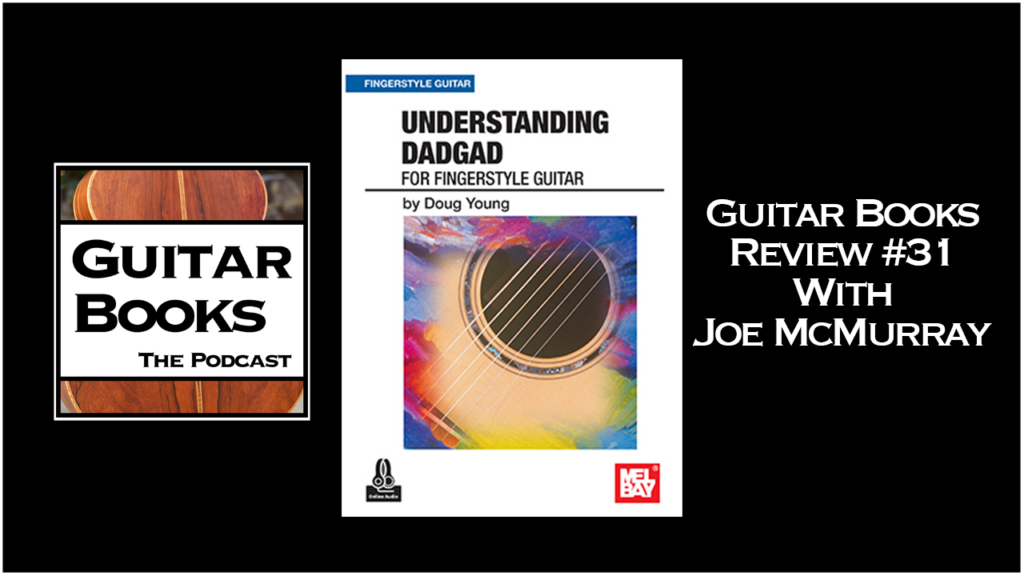
Review #31: Understanding DADGAD by Doug Young

May 14, 2026 by joemcmurray Leave a Comment

https://media.blubrry.com/music_books/content.blubrry.com/music_books/Guitar_Books_Ep_31_Understanding_DADGAD_2026_05_05.mp3

Podcast: Play in new window | Download (Duration: 25:56 — 35.8MB) | Embed

Subscribe: Apple Podcasts | RSS | More

Is this one of the best or worst method or repertoire books for learning to play acoustic fingerstyle blues guitar?

You can learn to play music using a variety of resources including teachers, online resources, and books.

Understanding DADGAD for Fingerstyle Guitar is a method book for… learning to play fingerstyle guitar using the wonderous alternate tuning known as DADGAD tuning.  This tuning is often associated with Celtic fingerstyle (Pierre Bensusan and Tony McManus), the British folk revival of the 1960s (Davy Graham), and modern fingerstyle (Andy McKee), but it truly excels in any genre.  

So, if you have some fingerstyle or classical guitar experience and you have an interest in beginning to utilize DADGAD tuning, this book will provide a comprehensive introduction.  Be aware, it is appropriate for intermediate to advanced fingerstyle guitarists.  Do not try to work through this book if you are just starting out with acoustic fingerstyle guitar – you really need to have the basics down before starting in this book.

Understanding DADGAD covers a lot of ground with regards to this alternate tuning, starting out by showing you simple chords, the basics of fretboard navigation, a few easier arrangements, and some accessible ideas for improvisation.  The book provides useful insights into how to leverage your knowledge of standard tuning to facilitate your learning of DADGAD – your 3rd, 4th and 5th strings are tuned the same as in standard tuning, while your 1st, 2nd, and 6th strings are tuned exactly one whole step down.  The book also does a great job introducing you to many of DADGAD’s unique characteristics – the tuning is especially well-suited to the harp-like cross-string technique, the use of drones, and the use of octaves paired with hammer-ons, pull-offs, and slides.

Where the book falls a little flat is that it doesn’t effectively show you how to arrange a tune in DADGAD tuning.  Upon completion of the book, you may have a few cool DADGAD tunes that you can play, but you may not know how to apply your newly acquired familiarity with the tuning to other music.  Personally, I am always arranging tunes for fingerstyle guitar, and while some tunes work great in standard tuning or drop-D, others seem to shine in DADGAD.  I recently arranged the Guns ‘N Roses hit, “Sweet Child of Mine,” to beef up my set-list for bars and breweries, and I started out arranging the tune in standard tuning.  It wasn’t sitting right in the original key, so I transposed it a couple times, but still didn’t like the results.  Finally, I arranged it in DADGAD and voila, the result was lush, musically satisfying, and playable/performable.  Here’s a sample of that arrangement.

My recommendation is that all fingerstyle players learn to arrange tunes in standard tuning, drop-D, and DADGAD.  While Understanding DADGAD doesn’t cover this topic, it does give you lots of tools (intervals, cross-string technique, etc.) to use in any future DADGAD arranging.  In my eBook, Arranging for Fingerstyle Guitar, I show you how to arrange Twinkle, Twinkle, Little Star in multiple keys in standard and alternate tunings (including DADGAD).  You can also check out my video/podcast series: Arranging Melodies for Fingerstyle Guitar, in which I show you how to arrange examples from the Essential Elements Guitar Method.  I’ll put a link to these videos in the corner and in the show description.

A nice supplement to Understanding DADGAD would be another book from our author: A DADGAD Christmas, again, also by Doug Young.  This other book contains great DADGAD arrangements of Christmas carols that you can both play and analyze to gain arranging insights.

Understanding DADGAD provides both treble clef and tablature for each arrangement.  Unfortunately, no fingerings are provided in the music.  For each example, I notated my own fingering in the music, after which I was able to play much more smoothly, accurately, and confidently.  The skill of choosing sensible fingering is important, and you will need to look elsewhere to further develop this skill.

Recordings are available online through Mel Bay’s website.  These will be very helpful to many readers.

© 2008 by Mel Bay

My own books:

Arranging for Fingerstyle Guitar: go to http://joemcmurray.com/checkout/ to purchase a pdf of my eBook.  Learning to arrange melodies will also help your fingerstyle songwriting and your understanding of the inner workings of fingerstyle guitar.

Fingerstyle Blues Guitar: An In-Depth Study of the 12-Bar Blues in E Major – Books 1 and 2 are available in paperback or as an eBook through Amazon [https://a.co/d/g7Udsso (Book 1) and https://a.co/d/aDbh4H0 (Book 2)].  The first priority of these books is to quickly get you playing a solo instrumental 12-bar blues, and then to build on it until you can freely improvise or “jam.” You should be up and running by the end of the third chapter, and each following chapter will add icing on the cake.  There is an focus on using a monotonic bass to maximize melodic freedom, and there is an emphasis on creating lyrical melodies using actual lyrics.

My upcoming book, Arranging for Fingerstyle Ukulele, will be published by Mel Bay in 2026.

My music is available on all streaming platforms at https://open.spotify.com/artist/5dcokTG6C598OhTslHH5uo?si=hrQb7FViSZewDRSgECw9Ew:

Pins on the Map: my third fingerstyle guitar album was released on January 19, 2024. Watch the first single, “Open Road,” on YouTube here: https://youtu.be/uPBh8sZQsT4?si=EM_wAwnHFqU1VC9C.

Riding the Wave and Acoustic Oasis: my first two fingerstyle guitar albums.

Arranging Melodies for Fingerstyle Guitar: Essential Elements Example 29

May 5, 2026 by joemcmurray Leave a Comment

https://media.blubrry.com/music_books/content.blubrry.com/music_books/Guitar_Books_Ep30_2_Arranging_Melodies_Ex29_2026_04_28.mp3

Podcast: Play in new window | Download (Duration: 16:46 — 23.2MB) | Embed

Subscribe: Apple Podcasts | RSS | More

Welcome back to my mini-series on how to become a better acoustic fingerstyle guitarist through the use of general guitar method books.  I’ll show you how to arrange melodies from:

  • Essential Elements for Guitar: Comprehensive Guitar Method, and
  • Hal Leonard’s Guitar Method Book 1

These books contain many of the exact same exercises.

When you arrange a tune for fingerstyle guitar, your goal is to take an unadorned melody and to put all of that fingerstyle goodness underneath.  This means that you will simultaneously play the melody and the harmony.  Sometimes you’ll even want to add percussive elements.  You want to sound like a full band all by yourself.

My arranging process has been codified in my book Arranging for Fingerstyle Guitar, which is available as an eBook which you can purchase through the link below.

In today’s video, I’ll walk you through the process of arranging Example 29 from the Essential Elements book.

My own books:

Arranging for Fingerstyle Guitar: go to http://joemcmurray.com/checkout/ to purchase a pdf of my eBook.  Learning to arrange melodies will also help your fingerstyle songwriting and your understanding of the inner workings of fingerstyle guitar.

Fingerstyle Blues Guitar: An In-Depth Study of the 12-Bar Blues in E Major – Books 1 and 2 are available in paperback or as an eBook through Amazon [https://a.co/d/g7Udsso (Book 1) and https://a.co/d/aDbh4H0 (Book 2)].  The first priority of these books is to quickly get you playing a solo instrumental 12-bar blues, and then to build on it until you can freely improvise or “jam.” You should be up and running by the end of the third chapter, and each following chapter will add icing on the cake.

My upcoming book, Arranging for Fingerstyle Ukulele, will be published by Mel Bay in 2026.

My music is available on all streaming platforms at https://open.spotify.com/artist/5dcokTG6C598OhTslHH5uo?si=hrQb7FViSZewDRSgECw9Ew:

Pins on the Map: my third fingerstyle guitar album was released on January 19, 2024. Watch the first single, “Open Road,” on YouTube here: https://youtu.be/uPBh8sZQsT4?si=EM_wAwnHFqU1VC9C.

Riding the Wave and Acoustic Oasis: my first two fingerstyle guitar albums.

  • Page 1
  • Page 2
  • Page 3
  • Interim pages omitted …
  • Page 8
  • Go to Next Page »

Footer

Website by Erin Girardi

Subscribe to Podcast

Apple PodcastsAndroidby EmailRSSMore Subscribe Options

Copyright © 2026 · Atmosphere Pro on Genesis Framework · WordPress · Log in

  • Music
  • Services
  • Lessons
  • Bio
  • eBooks
  • Guitar Books the Podcast
  • Merch
  • Join the List
  • Weddings
  • Booking / Merch Order Form