• Skip to primary navigation
  • Skip to main content
  • Skip to footer

Joe McMurray Music

Music for any occasion

  • Music
  • Services
  • Lessons
  • Bio
  • eBooks
  • Guitar Books the Podcast
  • Merch
  • Join the List
  • Weddings
  • Booking / Merch Order Form

Fingerstyle

Review #14: Christmas Repertoire Books for Solo Fingerstyle Guitar

December 1, 2023 by joemcmurray Leave a Comment

https://media.blubrry.com/music_books/content.blubrry.com/music_books/Guitar_Books_Ep_14_Christmas_Repertoire_for_Solo_Fingerstyle_Guitar_2023_11_30.mp3

Podcast: Play in new window | Download (Duration: 32:42 — 45.0MB) | Embed

Subscribe: Apple Podcasts | RSS | More

Christmas repertoire books featuring solo fingerstyle guitar arrangements are great for the holiday season!  Whether you simply want to get into the Christmas spirit or you need to perform Christmas tunes at your gigs, there are a number of great Christmas repertoire books.  In this review I will look at three books that I really enjoy: Hal Leonard’s “Fingerpicking Yuletide,” Mark Phillips’ “Christmas Carols for Easy Classical Guitar” (Cherry Lane Music Company), and John Hill’s “Classical Guitar Christmas Sheet Music” (Hal Leonard).

To be clear, all books are suitable for either steel string guitar or nylon string classical guitar.

All three books feature a range of tunes suitable for late-beginner through intermediate fingerstyle guitarists.  Hal Leonard’s “Fingerpicking Yuletide” features mid-twentieth century tunes like Frosty the Snowman, Jingle Bell Rock, and Let It Snow! Let It Snow! Let It Snow!  Phillips’ “Christmas Carols for Easy Classical Guitar” and Hill’s “Classical Guitar Christmas Sheet Music” both feature traditional Christmas carols like O Come, All Ye Faithful, The First Noel, Jingle Bells, and Silent Night.

Hal Leonard’s “Fingerpicking Yuletide” and Phillips’ “Christmas Carols for Easy Classical Guitar” provide both standard notation and tablature, but Hill’s “Classical Guitar Christmas Sheet Music” provides only standard notation (no TAB!!!).

The arrangements in Phillips’ “Christmas Carols for Easy Classical Guitar” flow really well with nice arpeggiation.  The arrangements in Hill’s “Classical Guitar Christmas Sheet Music” are a mixed bag, but many of them have nice arpeggiation or feature an alternating bass line (Travis picking).  Some of the arrangements are a bit clunky in comparison to the Phillips book.  The arrangements in Hal Leonard’s “Fingerpicking Yuletide” are also a mixed bag, but tend to be a little stripped down/simplified to make them easier.  While some are great as they are, some are a little uninspiring until you add some extra inner harmony, arpeggiation, or other pizzazz.  The arrangements are great for late-beginner/intermediate players, and they are excellent skeletons/frameworks/starting points from which more advanced players can add extra spice.  The arrangements utilize a variety of alternating bass lines and arpeggiation.

Hal Leonard’s “Fingerpicking Yuletide” has 16 tunes.  Phillips’ “Christmas Carols for Easy Classical Guitar” has 22 tunes.  Hill’s “Classical Guitar Christmas Sheet Music” has 30 tunes.

Hal Leonard’s “Fingerpicking Yuletide” is the only book out of the three that has the lyrics written into the music which is nice when playing with friends/family or for helping you to sing the melody out loud or in your head while you are playing solo.

Phillips’ “Christmas Carols for Easy Classical Guitar” is the only book out of the three that comes with recordings of the tunes (mine came with a CD).

All three books are worth buying – it just depends on what you’re looking for.

My eBook: Arranging for Fingerstyle Guitar: go to http://joemcmurray.com/checkout/ to purchase a pdf of my eBook.

My music is available on all streaming platforms:

Pins on the Map: my third fingerstyle guitar album will be released in January 2024. The first single, “Open Road,” was released 10/20/23. Watch it on YouTube here: https://youtu.be/uPBh8sZQsT4?si=EM_wAwnHFqU1VC9C.  Three other singles have since been released: “Lost and Found,” “The Matador,” and “Pins on the Map.”

Riding the Wave and Acoustic Oasis: my first two fingerstyle guitar albums.
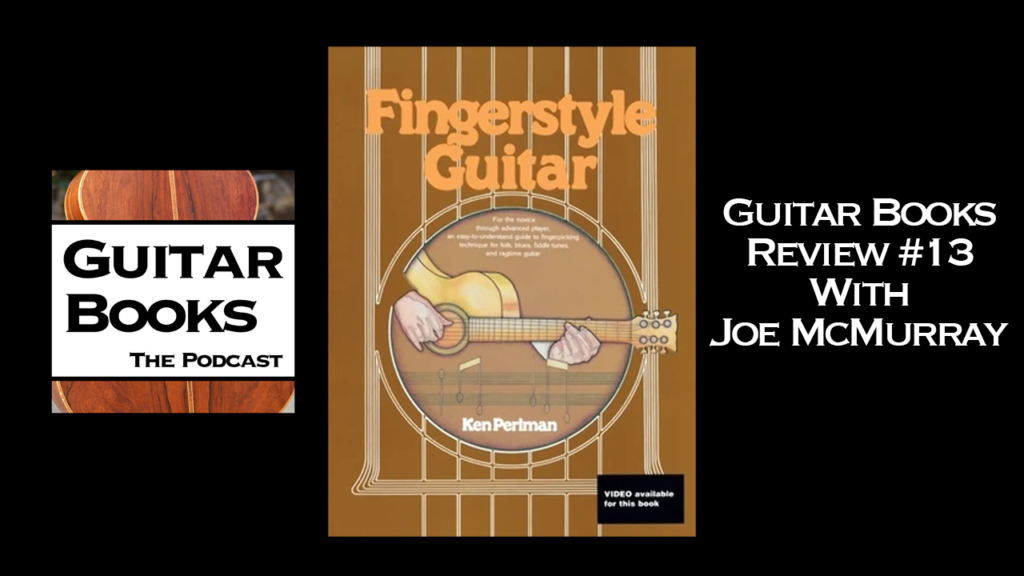
Review #13: Fingerstyle Guitar by Ken Perlman

November 25, 2023 by joemcmurray Leave a Comment

https://media.blubrry.com/music_books/content.blubrry.com/music_books/Guitar_Books_Ep_13_Perlman_Fingerstyle_Guitar_2023_11_11.mp3

Podcast: Play in new window | Download (Duration: 23:15 — 32.1MB) | Embed

Subscribe: Apple Podcasts | RSS | More

Is this one of the best or worst method books for fingerstyle guitar?

You can learn to play music by simultaneously using a variety of resources including teachers, online resources, and books.

Ken Perlman’s Fingerstyle Guitar is a method book for learning to play solo fingerstyle guitar in the folk, blues, fiddle tune, Celtic, and ragtime styles.  The book becomes progressively more difficult – the beginning is appropriate for beginner fingerstyle players, and the end is challenging for intermediate and even advanced players.  The book is extremely long (232 pages) and extremely detailed with sections of dense explanatory text.  While I enjoy many of the tunes in this book (especially the Irish, English, and Scottish fiddle tunes), some of the arrangements are clunky, difficult, and not worth the effort.  While I’m happy to have worked through Fingerstyle Guitar, I would not recommend this to most players unless you are specifically interested in older styles of music and you’ve already exhausted other options.

The book quickly introduces alternating bass (Travis picking) arrangements and gradually presents standard guitar techniques including hammer-ons, pull-offs, slides, etc.  I like that Perlman provides exercises and lots of short, accessible tunes like Elizabeth Cotton’s Freight Train to build your technique.  The tunes and arrangements are stylistically similar to those in Stefan Grossman’s Complete Country Blues Guitar Book and Complete Celtic Fingerstyle Guitar Book but with more technical explanations.  The book also provides types of tunes similar to those found in Mel Bay’s Complete Chet Atkins Guitar Method although with a very different teaching approach.

While the first five chapters of the book are accessible with some fun 20 second tunes, the book’s difficulty increases starting in Chapter 6.  The tunes move higher up the fretboard, utilizing alternate tunings, and requiring much more fretting with your thumb over the top.  These are important things to learn and prepare you for the fun repertoire-heavy chapters at the end of the book.

The final four chapters of the book provide repertoire tunes organized into categories: “Southern Fiddle Tunes,” “Old-Time Songs and Ballads,” “Irish, English, and Scottish Fiddle Tunes,” and “Rags.”  There are some nice arrangements in these chapters, but I found that many of the arrangements seem to be especially difficult.  I believe that a good arrangement should find a balance between the complexity of the tune and playability, and many of these arrangements just feel clunky to me.  Lots of difficult passages and fingerings even after putting in serious practice.  There are detailed explanations of techniques (hammer-ons, slides, etc.), but little explanation of how to actually play through an individual tune with a smooth performance.  Other books like Richard Saslow’s The New Art of Ragtime Guitar provide smoother arrangements and much more tune-specific help.

If you are a performing musician, you will find that most of these tunes are too short to actually play out at gigs without coming up with your own variations.  The exceptions are the rags in the final chapter which are quite lengthy and difficult.  For the shorter tunes throughout the book, there is no discussion about how to go about extending them for performance.

Perlman provides some cool background information on styles and specific tunes.  The Celtic fiddle tune chapter has great information on the differences between single jigs, double jigs, slip jigs, set tunes, reels, hornpipes, and slow aires, with great examples of each.

The book provides examples in both TAB and standard notation (treble clef).  Each tune/example is presented in its entirety in TAB, and then again in standard notation.  This is great in that it minimizes page turns if you are reading the tune.  It is also highly annoying because all of the fingering details are only included in the standard notation, so if you are reading the TAB version of the tune, you have to constantly flip over and search through the standard notation version.  The author/publisher should have included the fingerings in the TAB.  Also, after the beginning of the book, there is no right hand fingering.

Overall, this book contains a wide scope of valuable information and fun old folk, blues, fiddle, Celtic, and ragtime tunes.  Many of the arrangements feel clunky and difficult to me even after putting in a lot of work.  Many of the explanations of techniques are helpful if you’ve never used them before but are hard to read.  If you want to play fingerstyle guitar, don’t start with this book.

The book doesn’t get into the modern percussive techniques used by modern players like Michael Hedges, Don Ross, Andy McKee, Mike Dawes, etc.  No thumb slaps, guitar body percussion, or tapping.

I recommend using an acoustic steel string guitar rather than a classical guitar since there are many tunes that utilize the fretting hand thumb over the top.

Published by Centerstream Publishing  © 1980, 2002.  Distributed by Hal Leonard.

My eBook: Arranging for Fingerstyle Guitar: go to http://joemcmurray.com/checkout/ to purchase a pdf of my eBook.

My music is available on all streaming platforms:

Riding the Wave: my second fingerstyle guitar album.

Pins on the Map: my third fingerstyle guitar album will be released in January 2024. The first single, “Open Road,” was released 10/20/23. Watch it on YouTube here: https://youtu.be/uPBh8sZQsT4?si=EM_wAwnHFqU1VC9C.  The second single, “Lost and Found,” was released 11/3/23.

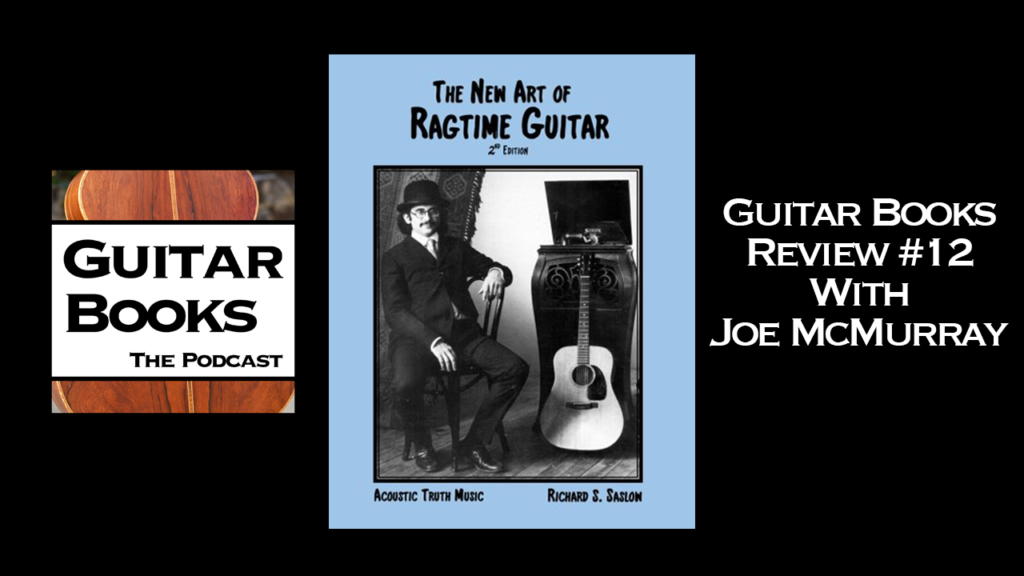
Review #12: The New Art of Ragtime Guitar by Richard Saslow

October 28, 2023 by joemcmurray Leave a Comment

https://media.blubrry.com/music_books/content.blubrry.com/music_books/Guitar_Books_Ep_12_Saslow_New_Art_of_Ragtime_2023_10_05.mp3

Podcast: Play in new window | Download (Duration: 17:06 — 23.6MB) | Embed

Subscribe: Apple Podcasts | RSS | More

Is this one of the best or worst method books for fingerstyle guitar?

You can learn to play music using a variety of resources including teachers, online resources, and books.

Richard S. Saslow’s The New Art of Ragtime Guitar is a fun, well-graduated repertoire + analysis book for learning to play the fingerpicking guitar style known as ragtime guitar.  It is aimed at intermediate and advanced fingerstyle players, although late beginners can certainly take a stab at the first couple tunes.  The book teaches ragtime guitar through studies of 8 tunes of increasing difficulty.  Each tune is broken down into sections with around 6 measures of the music (treble clef and tablature) on one page and a detailed analysis on the facing page.  Full condensed tunes are in the back of the book.

Out of the author’s eight original tunes, seven are standard sounding ragtime tunes and one is a blues.  Among the ragtime tunes, there is a bit of variation in feel from upbeat and happy to bluesy and minor to jazzy.  There are also several key signatures and some unique harmonizations.  All of the ragtime tunes utilize an alternating bass line as well as some short segments of walking bass line.  The blues tune mainly uses a monotonic bass typical of the Texas blues fingerpicking style.

This is not a method book for learning the basics of fingerstyle guitar in a logical progression from your first notes through to mastery (check out Alfred’s Beginning Fingerstyle, Hal Leonard’s Fingerstyle Guitar, or Mel Bay’s Complete Chet Atkins Guitar Method).  However, there are about 20 pages of introductory text discussing equipment, notation, the ragtime style, and technique.  There is definitely some useful information in this section, especially for novice players.  However, I wouldn’t get too caught up reading this entire section all at once – I would recommend jumping into the tunes which often refer you back to the technique sections of the introduction.  Read the detailed stuff then!

Where the book really excels is in its presentation of the music and its corresponding analysis.  As I mentioned before, for each ragtime tune you will see ~6 measures of music on one page and the detailed analysis on the facing page.  This analysis features detailed directions, techniques, and other tips for the 6 measures at hand.  I usually play through the music once, and then go through the analysis carefully, marking fingerings, anchor fingers, guide fingers, etc. into the music as well as into the condensed version of the tune in the back of the book.  The analysis really does give you insights into how to properly play these tunes (and future tunes from any source) smoothly and musically.

  1. Authentic sounding fingerstyle ragtime tunes.
  2. Good difficulty graduation.
  3. You will spend much more time playing music than analyzing music theory. 
  4. Online recordings of each tune are available.

The book doesn’t get into the modern percussive techniques used by modern players like Michael Hedges, Don Ross, Andy McKee, Mike Dawes, etc.  No thumb slaps, guitar body percussion, or tapping.

I recommend using an acoustic steel string guitar rather than a classical guitar since there are multiple tunes that utilize the fretting hand thumb over the top.

Independently published by the author via Acoustic Truth.  © 2011, 2017 (2nd edition)

eBook: Arranging for Fingerstyle Guitar: go to http://joemcmurray.com/checkout/ to purchase a pdf of my eBook.

Riding the Wave: my second fingerstyle guitar album is available on all streaming platforms.

Pins on the Map: my third fingerstyle guitar album will be released in January 2024. The first single, “Open Road,” was released 10/20/23. Watch it on YouTube here: https://youtu.be/uPBh8sZQsT4?si=EM_wAwnHFqU1VC9C

Review #11: Fingerstyle Blues by Miggs Rivera

September 26, 2023 by joemcmurray Leave a Comment

https://media.blubrry.com/music_books/content.blubrry.com/music_books/Guitar_Books_Ep_11_Rivera_Fingerstyle_Blues_2023_09_24.mp3

Podcast: Play in new window | Download (Duration: 18:19 — 25.3MB) | Embed

Subscribe: Apple Podcasts | RSS | More

Is this one of the best or worst method books for fingerstyle blues guitar?

You can learn to play music using a variety of resources including teachers, online resources, and books.

Miggs Rivera’s Fingerstyle Blues is an inspiring, well-graduated method book for learning to play fingerstyle blues.  It is aimed at intermediate and advanced fingerstyle players.  Each chapter ultimately provides a full performance tune, but starts by describing a new concept or technique (or two) and providing examples that prepare you for the performance song.  As advertised, this book is focused entirely on fingerstyle blues with deep dives into various substyles including delta blues (Robert Johnson), boogies (John Lee Hooker), slide blues (Son House), and Texas blues (Lightning Hopkins).  There is even a tune that has a modern character with some jazzier chords.

I love how in each chapter the book provides technical exercises that directly prepare you for the upcoming performance tune.  Often the author will simplify a section of the performance tune and then provide more complexity with each subsequent example.  The first chapter of the book presents a somewhat basic 12-bar blues, then provides 5 separate 12-bar variations that each focus on adding a new technique (hammer-on grace notes, slide grace notes, rubato bends, chords fragments, rubato bends on the higher and lower strings), and finally culminates in an all-inclusive performance tune.  Mr. Rivera really hit the nail on the head with his teaching approach.

The author provides some music theory, but only that which is immediately applicable to an upcoming performance tune.  You will spend much more time playing music than analyzing music theory. 

The book includes access to private/un-searchable YouTube video lessons through QR codes.  You will need a cell phone that can pull these up.  These videos are extremely helpful as they include explanations and demonstrations by the author.  These are particularly useful as they show you the proper rhythms and feel.

One thing to note about this book is that it doesn’t emphasize improvisation which is a huge part of blues music.  However, you could learn about improvisation elsewhere (with a private teacher or with a book like Joseph Alexander’s Fingerstyle Blues Guitar) and then implement it into the tunes of this book.

  1. Authentic sounding fingerstyle blues tunes.
  2. Excellent difficulty graduation – examples build off each other and get gradually more complex and difficult.  Cohesive feel throughout the book, especially as the final performance tune pulls from the earlier tunes.
  3. Not much emphasis on improvisation.
  4. Online video lessons are extremely helpful – difficult rhythms and feel are much easier to learn with the videos.

The book does introduce some modern percussive techniques used by modern players like Michael Hedges, Don Ross, Andy McKee, Mike Dawes, etc.  You will learn to play thumb slaps and various percussive hits on the guitar body.

I would recommend that you use an acoustic steel string or electric guitar.  You could use a nylon string classical guitar if absolutely necessary, but I wouldn’t recommend it.

Independently published by Miggs Rivera.  © 2020

eBook: Arranging for Fingerstyle Guitar: go to http://joemcmurray.com/checkout/ to purchase a pdf of my eBook.

Riding the Wave: my second fingerstyle guitar album is available on all streaming platforms.

Pins on the Map: my third fingerstyle guitar album will soon be released.

Temporary Break!

July 5, 2023 by joemcmurray Leave a Comment

https://media.blubrry.com/music_books/content.blubrry.com/music_books/Guitar_Books_Ep_10_5_Taking_a_Break_2023_06_20.mp3

Podcast: Play in new window | Download (Duration: 1:02 — 2.4MB) | Embed

Subscribe: Apple Podcasts | RSS | More

I’ll be back with more guitar book reviews, but I need to take a little break while I work my way through new books, prepare for performances, finish recording/mixing/mastering my third fingerstyle guitar album, and write my upcoming book.

eBook: Arranging for Fingerstyle Guitar: go to http://joemcmurray.com/checkout/ to purchase a pdf of my eBook.

Riding the Wave: my second fingerstyle guitar album is available on all streaming platforms.

Review #10: 100 Most Popular Songs for Fingerpicking Guitar by Hal Leonard

June 15, 2023 by joemcmurray Leave a Comment

https://media.blubrry.com/music_books/content.blubrry.com/music_books/Guitar_Books_Ep_10_100_Popular_Songs_Hal_Leonard_2023_06_06.mp3

Podcast: Play in new window | Download (Duration: 22:15 — 30.7MB) | Embed

Subscribe: Apple Podcasts | RSS | More

You can learn to play music using a variety of resources including teachers, online resources, and books.

Hal Leonard’s 100 Most Popular Songs for Fingerpicking Guitar is a repertoire book filled with solo fingerstyle guitar arrangements of popular songs from mostly the 1960s through present day.  Genres covered include classic and modern rock, pop, folk, jazz, theme songs, Spanish classical, and more.  There are songs from the Beatles, Ed Sheeran, Duke Ellington, Metallica, Aerosmith, Imagine Dragons, Bob Marley, Stevie Wonder, etc.  Most of the tunes are suitable for intermediate fingerstyle players, although there are some easier tunes for late beginners as well as some tunes that are significantly more difficult.  If you are looking to build out your repertoire for local gigs, this book is incredible! 

Overall, the arrangements are in guitar-friendly keys, they stay below the 5th fret, and they sound good.  You can always simplify or add to the arrangements to suit your tastes and skill level.  Most tunes are in standard tuning, although there are some tunes that use drop D tuning.  Tunes are arranged utilizing a variety of techniques including simple melody and bass, alternating bass, and arpeggiation. The book doesn’t get into the modern percussive techniques used by modern players like Michael Hedges, Don Ross, Andy McKee, Mike Dawes, etc.  No thumb slaps, guitar body percussion, or tapping.

Although this book is a repertoire book and not a method book, there is a single page in the back providing an “Introduction to Fingerstyle,” which is probably worthless to anyone who is attempting to play the tunes in this book.  The rest of the book is just filled with song arrangements in alphabetical order, and there is no background information for any of the tunes.  The music is presented as a treble clef lead sheet with the main melody and the harmonizing chords written above, and the solo guitar arrangements are presented in treble clef and tablature.  Occasional left-hand fingerings are provided.

Although this book has great tunes for your gigs, it would be difficult to bring the book to a gig and play from the pages.  The book is 430 pages and has a softcover binding, so you need binder clips to hold the pages open.  Most tunes require multiple page turns, which is a disaster if you are holding the pages open with binder clips.  Your only options would be to photocopy pages or memorize the tunes.

For most of the tunes you could use an acoustic steel string or classical nylon string guitar since most arrangements don’t require using your fretting hand thumb over the top.

  1. Extensive song selection.  You are bound to like at least a few of the tunes if you like popular or rock music.
  2. Great arrangements that generally feature melody and bass, alternating bass, and/or arpeggiation.
  3. Provides treble clef lead sheets (melody with harmonizing chords written above) as well as treble clef and TAB guitar arrangements.
  4. Some fretting hand fingering is included, but there isn’t any picking hand fingering.
  5. Hard to hold pages open, lots of page turns.
  6. No audio access.  However, arrangements generally sound similar to the original tunes.

Published by Hal Leonard.  © 2019

eBook: Arranging for Fingerstyle Guitar: go to http://joemcmurray.com/checkout/ to purchase a pdf of my eBook.

Riding the Wave: my second fingerstyle guitar album is available on all streaming platforms.

  • « Go to Previous Page
  • Page 1
  • Interim pages omitted …
  • Page 3
  • Page 4
  • Page 5
  • Page 6
  • Page 7
  • Go to Next Page »

Footer

Website by Erin Girardi

Subscribe to Podcast

Apple PodcastsAndroidby EmailRSSMore Subscribe Options

Copyright © 2026 · Atmosphere Pro on Genesis Framework · WordPress · Log in

  • Music
  • Services
  • Lessons
  • Bio
  • eBooks
  • Guitar Books the Podcast
  • Merch
  • Join the List
  • Weddings
  • Booking / Merch Order Form