• Skip to primary navigation
  • Skip to main content
  • Skip to footer

Joe McMurray Music

Music for any occasion

  • Music
  • Services
  • Lessons
  • Bio
  • eBooks
  • Guitar Books the Podcast
  • Merch
  • Join the List
  • Weddings
  • Booking / Merch Order Form

classical

Comparison #4: Best Classical Methods for Fingerstyle Guitarists

May 29, 2026 by joemcmurray Leave a Comment

https://media.blubrry.com/music_books/content.blubrry.com/music_books/Guitar_Books_Comp_4_Best_Classical_for_FS_2026_05_21.mp3

Podcast: Play in new window | Download (Duration: 20:30 — 28.3MB) | Embed

Subscribe: Apple Podcasts | RSS | More
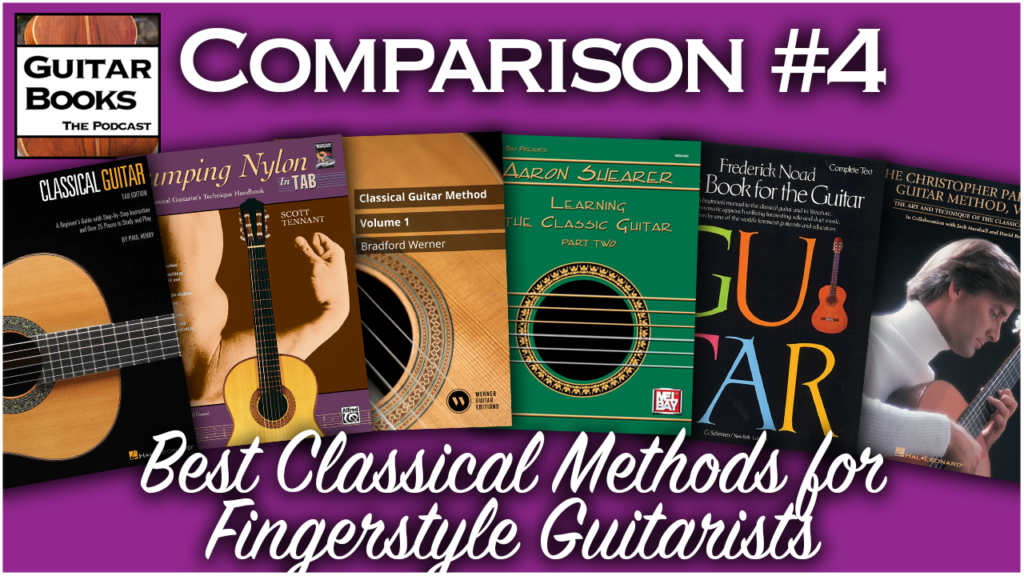
Do you want to become a better fingerstyle guitarist?  Today I’m here to talk about how studying classical guitar technique and repertoire will elevate your fingerstyle playing.  Additionally, I will present my favorite classical guitar method books for fingerstyle players.  Please note, I am aiming this video specifically at fingerstyle players and not aspiring classical guitar players, although I will offer some thoughts on which books may be best for classical guitarists.

I’ve wanted to make this video for some time because my own playing has improved so dramatically since I began seriously studying classical guitar.  Classical guitar training involves an emphasis on making smart fingering choices and refining your technique, which translates to consistent accuracy, greater speed, and maximizing your tone.  It involves an emphasis on lyrical phrasing, musicality, a sense of time, and more.  All of this training has given my playing a general fluidity, regardless of whether I’m playing on steel or nylon strings.

The realms of classical and fingerstyle guitar are closely related.  They both obviously focus on playing the guitar using the picking hand fingers rather than a flatpick.  They both involve the study of accompaniment and solo guitar playing.  And, most of the physical techniques and musicality involved in classical guitar playing translate extremely well back to the fingerstyle world.

There are obviously some differences between these two realms of guitar, starting with a preference for nylon vs. steel strings, and a preference for classical vs. non-classical repertoire.  If you are just testing the waters and don’t have a nylon-string classical guitar, just use your steel string guitar to get started.  Don’t let the lack of a classical guitar be a barrier to entry.

Next, certain techniques are emphasized more in one realm or the other – for example, classical guitarists place more emphasis on the use of the rest stroke, but the technique can certainly be effective on a steel string guitar.  On the other side of things, fingerstyle guitarists are more likely to use the Travis style technique, but it is easy to find 19th century classical guitar studies utilizing a familiar alternating bass pattern. 

Finally, for now, the classical guitar world generally places more importance on the ability to read standard notation (treble clef).  I have a couple recommendations for classical guitar method books that utilize tablature, but most books involve learning how to read standard notation.  For some of you, just jumping into one of the tablature options and learning about technique and fingering will provide an immediate boost.  For others, it may be worth the effort to work through one of the excellent standard notation methods – you will learn to read while simultaneously boosting your chops.  And then you will forevermore be able to work through other classical guitar method and repertoire books, you’ll be able to read the vocal melodies from lead sheets (which is really helpful when arranging for fingerstyle guitar), you’ll have access to centuries of repertoire (for the guitar and other instruments), and you’ll be able communicate more effectively with other musicians.

When you decide to make this investment in yourself, I want you to keep something in mind.  It doesn’t matter if you are learning to read standard notation or you’re using a tablature edition, and it doesn’t matter if you consider yourself to be an intermediate or even advanced player: DO NOT skip over those early exercises where you’re learning the notes on each string.  While learning or reviewing these notes, you should focus on playing with perfect technique and optimal tone.  You should work on your timing, your vibrato, your posture, and adding dynamics (even if they aren’t written into the music).  Never let yourself get so confident or even cocky that you think you’re too good to go back to the fundamentals.  I start my practice sessions with these fundamentals and several classical etudes every single day.  For the rest of each subsequent practice session, my fingers feel amazing, and I play at my very best.

Now, here are those tablature recommendations for those of you who want some of the benefits of classical guitar training without having to learn standard notation:

1) Hal Leonard Classical Guitar Method (TAB Edition) (Paul Henry, 2008)

2) Pumping Nylon – in TAB (Scott Tennant, originally 1995, TAB ed 1997, 2nd ed 2016)

Best Classical Guitar Method Books written in standard notation

Again, the Hal Leonard book would have made this list.

1) Classical Guitar Method: Volume 1 (Bradford Werner, 2019)

elodies harmonized by open strings.  You will need to move into Volume 2 if you want to look at placing fretted basslines under your melody – this is why I mentioned that the scope of Volume 1 is limited.

There is a “chord accompaniment” section which provides folk songs in lead sheet format – that is, with the melody written in treble clef along with the accompaniment chords or fingerstyle patterns.  This is great for players who want to accompany their voice.

The repertoire selection throughout the book includes many folk tunes, with only a few “classical” tunes.  Many of these tunes come with accompanying teacher-duet parts or harmonizing chords.

Within the book, the text is kept to a minimum, with very little emphasis on technique.

However, there are those supplemental videos available showing exercises performed and providing significant addition information.  If you want a book combined with video lessons, this is the most extensive that I’ve seen.  Instead of reading much of the information about technique, you’ll see it demonstrated.

Finally, this is a very short book with 102 pages, but large text.  And then, over 10 of those pages are note identification worksheets where notes are provided on the staff, and you are asked to write in the note names.  Overall, you don’t get nearly as much material in this book as the other method books that I’ll recommend today.

This is a great first book that comes with supplemental videos.  It doesn’t have nearly as many exercises and tunes.

2) Learning the Classic Guitar: Part Two (Aaron Shearer, 1990)

3) First Book for the Guitar (Frederick Noad, 1978)

4) The Christopher Parkening Guitar Method, Vol. 1 (Christopher Parkening, 1972)

My own books:

Fingerstyle Blues Guitar: An In-Depth Study of the 12-Bar Blues in E Major – Books 1 and 2 are available in paperback or eBook through Amazon [https://a.co/d/g7Udsso (Book 1) and https://a.co/d/aDbh4H0 (Book 2)]. The first priority of these books is to quickly get you playing a solo instrumental 12-bar blues, & then to build on it until you can freely improvise or “jam.” You should be up and running by the end of the third chapter, and each following chapter will add icing on the cake.

Arranging for Fingerstyle Guitar: go to http://joemcmurray.com/checkout/ to purchase a pdf of my eBook.

Arranging for Fingerstyle Ukulele, will be published by Mel Bay in 2026.

My music is available on all streaming platforms at https://open.spotify.com/artist/5dcokTG6C598OhTslHH5uo?si=hrQb7FViSZewDRSgECw9Ew:

Pins on the Map: my third fingerstyle guitar album was released on January 19, 2024. Watch the first single, “Open Road,” on YouTube here: https://youtu.be/uPBh8sZQsT4?si=EM_wAwnHFqU1VC9C.

Riding the Wave and Acoustic Oasis: my first two fingerstyle guitar albums.
Review #25: Christmas Rep for Solo Fingerstyle Guitar, 2025 Update

December 1, 2025 by joemcmurray Leave a Comment

https://media.blubrry.com/music_books/content.blubrry.com/music_books/Guitar_Books_Ep_25_Christmas_Books_2025_2025_11_18.mp3

Podcast: Play in new window | Download (Duration: 24:33 — 33.9MB) | Embed

Subscribe: Apple Podcasts | RSS | More

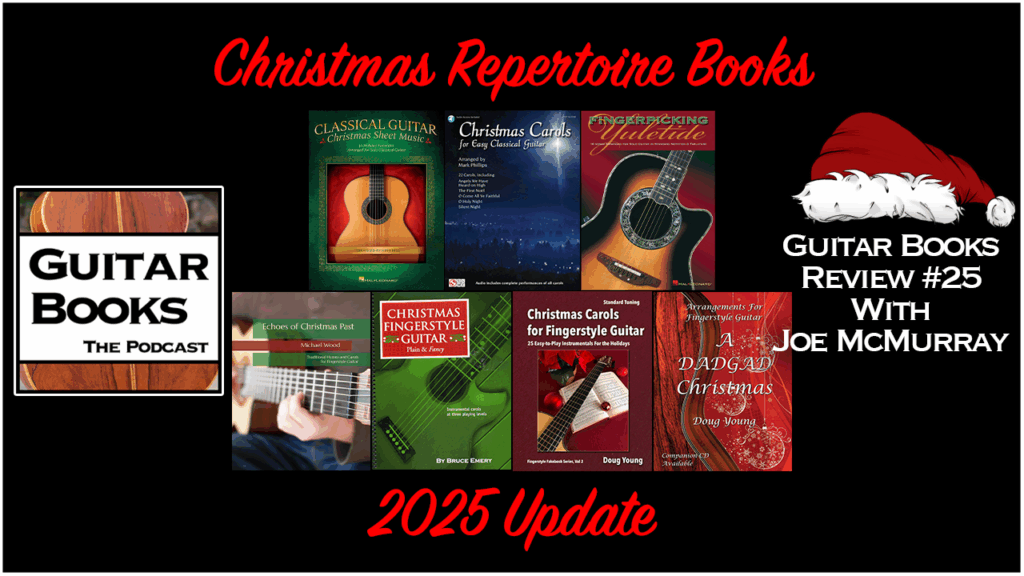
Christmas repertoire books featuring solo fingerstyle guitar arrangements are great for the holiday season!  Whether you simply want to get into the Christmas spirit or you need to perform Christmas tunes at your gigs, there are a number of great Christmas repertoire books.  Last year I did a similar multi-book review, but I need to put out an update since I have since gone on a buying spree and purchased 4 more books that I’d been curious about.  In this review I will look at the original three books that I reviewed:

  • Hal Leonard’s “Fingerpicking Yuletide,”
  • Mark Phillips’ “Christmas Carols for Easy Classical Guitar” (Cherry Lane Music Company), and
  • John Hill’s “Classical Guitar Christmas Sheet Music” (Hal Leonard)

As well as my four new books:

  • Michael Wood’s “Echoes of Christmas Past,”
  • Bruce Emery’s “Christmas Fingerstyle Guitar,” and
  • Doug Young’s “Christmas Carols for Fingerstyle Guitar” AND “A DADGAD Christmas.”

And finally I’ll mention one book that I don’t have, but I can see enough from previews to be able to compare to the other books:

  • Hal Leonard’s “Fingerpicking Christmas”

To be clear, all books are suitable for either steel string guitar or nylon string classical guitar.

I will demonstrate tunes from each book so that you can see and hear what you’re getting.

Now, whether you are just looking to enjoy playing holiday tunes for yourself, with your family and friends, or on stage, there are several factors to consider.  Christmas music is really only acceptable in the month of December, so if you are like me then you’ll start preparing in November.  As these tunes are kept on the shelf for 10 months of the year, I generally look for the easiest arrangements that still sound as good as possible.  I need to be able to whip these into shape in a reasonable amount of time.

Perhaps you (unlike myself) are looking for the most incredible sounding arrangements possible, regardless of their difficulty?  One of these books in particular fits that bill.

Another important factor to consider is whether you are looking to play instrumental arrangements or if you are looking to lead a singalong.  Some books are better suited to one or the other.

I’m going to try to guide you to the book or books that are best for YOU.  Each of these books is valuable in its own way, but one may fit you better. 

Hal Leonard’s “Fingerpicking Yuletide” is the only book out of these that has popular modern/mid-twentieth century tunes like Holly Jolly Christmas, Frosty the Snowman, Jingle Bell Rock, and Let It Snow!  Hal Leonard is a publishing giant and has the ability to publish these popular tunes that are protected by copyright.  Late-beginner/intermediate.  Pretty good arrangements, especially as a starting point.  No audio recordings.

All of the other books contain traditional Christmas carols like O Come, All Ye Faithful, The First Noel, Jingle Bells, and Silent Night.  These are all of the tunes that fall under the realm of public domain, so authors can arrange them without worrying about legal issues or royalties.

Out of all of these other books, two books stand out for containing beautiful, yet easy to play arrangements.  Wood’s “Echoes of Christmas Past” is #1, Phillips’ “Christmas Carols for Easy Classical Guitar” is #2.  Wood’s arrangements are incredibly playable and sound so so good.  Very flowing and arpeggiated with a folksy touch.  Never too many notes at once, so easy on the hands.  No lyrics written into the music, and no audio recordings.

Phillips’ arrangements also flow very well with lots of arpeggiation and pedaling on the open G string.  Definitely has some classical guitar vibes.  Once again, no lyrics, but this one does come with a CD for the audio recordings.

If you are the type of player who wants a simple arrangement that you can enhance, or if you want to lead a singalong and need a really straightforward arrangement, Bruce Emery’s “Christmas Fingerstyle Guitar: Plain and Fancy” and Doug Young’s “Christmas Carols for Fingerstyle Guitar” are very valuable books.  Each contains the most basic arrangements with block chords harmonizing each melody.  These are excellent for beginners and work great as lead sheets for intermediate and advanced players (as a platform from which you can create your own variations).  Young’s book is a bit easier.   Emery’s book provides each carol at three difficulty levels.  Emery’s has lyrics in the music so it works better for singalongs.  Young’s has lyrics on the opposite page from the music, so usable for singalongs, but not ideal.  Both provide audio recordings.  These two books are both great gigging books, but I if I had to choose, I’d rather have the Wood or Phillips book at a gig.

Doug Young’s “A DADGAD Christmas” is unique and incredibly beautiful.  Much more difficult in comparison – suitable for intermediate and advanced players.  Audio recordings are available on Spotify and make for great listening!  Some really satisfying arrangements, but not my first choice of Christmas gig book – I generally want Christmas gig tunes to be on the easier side.

Hill’s “Classical Guitar: Christmas Sheet Music” contains arrangements that can absolutely work on steel string guitars, but they are written only in treble clef.  These arrangements are all a bit more difficult to play, regardless of treble clef vs. TAB, and they don’t necessarily sound better than the arrangements of the other books.  Many arrangements just feel clunky with difficult fingering.  One thing that I do like is the arrangement of Tchaikovsky’s “March” from the Nutcracker, which you won’t find in any of the other books.  If you are a classical guitar teacher, these would definitely be useful to use with your students.  No audio recordings.

So, to organize all of this information:

  • Only one for mid-twentieth century tunes: Hal Leonard’s “Fingerpicking Yuletide”
  • Best for solo instrumental gigging: Wood’s “Echoes of Christmas Past” is #1, Phillips’ “Christmas Carols for Easy Classical Guitar” is #2.  Hal Leonard’s “Fingerpicking Yuletide”is an equally important gigging book for me too just because of its arrangements of popular tunes.
  • Best for singalongs: Hal Leonard’s “Fingerpicking Yuletide”, Bruce Emery’s “Christmas Fingerstyle Guitar: Plain and Fancy”, and possibly Hal Leonard’s “Fingerpicking Christmas”
  • Most beginner friendly: Probably Doug Young’s “Christmas Carols for Fingerstyle Guitar” orBruce Emery’s “Christmas Fingerstyle Guitar: Plain and Fancy,” then Wood’s “Echoes of Christmas Past” is #1, Phillips’ “Christmas Carols for Easy Classical Guitar”
  • Most sonorous arrangements: Doug Young’s “A DADGAD Christmas”
  • Don’t buy: Hill’s “Classical Guitar: Christmas Sheet Music”

Performance:

  • Holly Jolly Christmas, Frosty the Snowman – Hal Leonard’s “Fingerpicking Yuletide”
  • Come, All Ye Faithful – in all books other than Hal Leonard’s “Fingerpicking Yuletide” andDoug Young’s “A DADGAD Christmas”
  • Silent Night – in all books other than Hal Leonard’s “Fingerpicking Yuletide”

My own books:

Fingerstyle Blues Guitar: An In-Depth Study of the 12-Bar Blues in E Major – Books 1 and 2 are available in paperback or as an eBook through Amazon [https://a.co/d/g7Udsso (Book 1) and https://a.co/d/aDbh4H0 (Book 2)].  The first priority of these books is to quickly get you playing a solo instrumental 12-bar blues, and then to build on it until you can freely improvise or “jam.” You should be up and running by the end of the third chapter, and each following chapter will add icing on the cake.

Arranging for Fingerstyle Guitar: go to http://joemcmurray.com/checkout/ to purchase a pdf of my eBook.  Learning to arrange melodies will also help your fingerstyle songwriting and your understanding of the inner workings of fingerstyle guitar.

My upcoming book, Arranging for Fingerstyle Ukulele, will be published by Mel Bay in 2026.

My music is available on all streaming platforms at https://open.spotify.com/artist/5dcokTG6C598OhTslHH5uo?si=hrQb7FViSZewDRSgECw9Ew:

Pins on the Map: my third fingerstyle guitar album was released on January 19, 2024. Watch the first single, “Open Road,” on YouTube here: https://youtu.be/uPBh8sZQsT4?si=EM_wAwnHFqU1VC9C.Riding the Wave and Acoustic Oasis: my first two fingerstyle guitar albums.

Footer

Website by Erin Girardi

Subscribe to Podcast

Apple PodcastsAndroidby EmailRSSMore Subscribe Options

Copyright © 2026 · Atmosphere Pro on Genesis Framework · WordPress · Log in

  • Music
  • Services
  • Lessons
  • Bio
  • eBooks
  • Guitar Books the Podcast
  • Merch
  • Join the List
  • Weddings
  • Booking / Merch Order Form