• Skip to primary navigation
  • Skip to main content
  • Skip to footer

Joe McMurray Music

Music for any occasion

  • Music
  • Services
  • Lessons
  • Bio
  • eBooks
  • Guitar Books the Podcast
  • Merch
  • Join the List
  • Weddings
  • Booking / Merch Order Form

blues

Fingerstyle Blues Guitar by Joe McMurray

November 13, 2025 by joemcmurray Leave a Comment

https://media.blubrry.com/music_books/content.blubrry.com/music_books/Guitar_Books_Ep_Special_McMurray_FS_Blues_Long_Pitch_2025_11_06.mp3

Podcast: Play in new window | Download (Duration: 26:07 — 36.0MB) | Embed

Subscribe: Apple Podcasts | RSS | More

Is this one of the best or worst method books for learning to play acoustic fingerstyle blues guitar?

You can learn to play music using a variety of resources including teachers, online resources, and books.

Open with 12-bar blues performance

  • Imagine ripping a blues solo on stage with your band – your drummer and bassist providing a comfortable soundscape on which your tasty guitar lines can float.
  • Now imagine that you’re alone on your front porch with only an acoustic guitar – wouldn’t you like to be able to jam on the blues all by yourself?
  • There is a long tradition of fingerstyle blues
  • Although much fingerstyle blues music is mixed with vocals, solo instrumental tunes can be so much fun!
  • Welcome to Guitar Books the Podcast, my name is Joe McMurray

Show books

  • Unusual episode – I’m going to do a rundown my own recently published books, Fingerstyle Blues Guitar: An In-Depth Study of the 12-Bar Blues in the Key of E Major: Books 1 and 2
  • First priority of these books is to quickly get you playing a solo instrumental 12-bar blues, and then to build on it until you can freely improvise or jam.
  • You should be up and running by the end of the 3rd chapter, and each following chapter will add icing on the cake.
  • Organized the books so that the concepts and exercises progress logically, thoroughly, and with a smooth difficulty progression.
    • Take care to explain how to immediately apply each concept to your playing.
  • These are essentially one long book split down the middle: Book 2 picks up right where Book 1 left off.  It was just too long – it would have been around 350 pages.
  • I recommend that everyone start with Book 1, which is suitable for all skill levels.
    • Complete beginner players who work through the first few chapters should be able to improvise a satisfying fingerstyle blues solo.
    • Intermediate to advanced players will breeze through the first few chapters, but will hopefully pick up some useful information starting around Chapter 4.
  • Book 2 is more suitable for intermediate to advanced players.
    • It digs deeper into higher level concepts that are more technically and theoretically difficult, but will elevate your playing to new levels.
    • You will learn to play new scales, turnarounds, rhythms, time signatures, key signatures, and more!
  • Again, I recommend that everyone start with Book 1, and then move on to Book 2.
  • Not here to teach you every authentic Robert Johnson lick or every subgenre of fingerstyle blues.
  • You won’t learn and memorize a bunch of new tunes.
  • However, I will clearly lay out how to create a solo fingerstyle guitar performance in which you improvise over the 12-bar blues structure using a monotonic bassline.
  • You will master ONE platform through which you can channel endless creativity and put on a satisfying blues performance.
  • Lots of fingerstyle blues books on the market – why work through mine?
  • I love many of these other books, and I have learned a lot from them. 
  • The first thing that differentiates mine is its focus on playing the blues over a monotonic bassline. 
  • Most other books focus on playing the blues over an alternating bassline (Travis style) (although they may present some material on using a monotonic bassline).
  • One focuses on playing the blues over a monotonic bassline – Joseph Alexander’s Fingerstyle Blues Guitar.
    • I was honestly very influenced by this book, and I highly recommend it in addition to mine!
    • However, Alexander’s book focuses more on teaching you a bunch of authentic blues language and licks over the monotonic bassline, with less emphasis on putting together a full lyrical 12-bar solo, nonetheless a full multi-chorus performance.
    • My book starts from a more beginner-friendly place and builds with a much more gradual difficulty progression.  Easier melodies and rhythms at first, with many, many examples.
    • My book focuses on the bigger picture of putting together a cohesive blues chorus and then a cohesive multi-chorus performance.
  • I have spent a lot of time working through other books, I have real world experience, and I’ve tried to create a series of books that will be most effective at teaching you to actually jam on the blues.

Critical of my own books:

  • No recordings.  Need more time!  Two little kids. 
  • Wordy?

Review #23: Fingerstyle Blues Songbook by Steve James

November 6, 2025 by joemcmurray Leave a Comment

https://media.blubrry.com/music_books/content.blubrry.com/music_books/Guitar_Books_Ep_23_James_2025_10_27.mp3

Podcast: Play in new window | Download (Duration: 25:15 — 34.9MB) | Embed

Subscribe: Apple Podcasts | RSS | More

Is this one of the best or worst repertoire books for learning to play acoustic fingerstyle blues guitar?

You can learn to play music using a variety of resources including teachers, online resources, and books.

Steve James’ Fingerstyle Blues Songbook is a repertoire book drawing from various substyles of fingerstyle blues (general old time country blues, Delta blues, ragtime blues, Texas blues, and bottleneck blues).  Most of the tunes are suitable for late-beginner and intermediate fingerstyle players, although advanced players will certainly enjoy the tunes as well.  The music in this book may sound “old-timey” (much of it comes from the 1920s and 30s), but it is really fun to play if you are interested in the style.

This book is comparable to Stefan Grossman’s Complete Country Blues Guitar Book (Review #9).  Both are great resources.

Fingerstyle Blues Songbook includes solo fingerstyle guitar arrangements of 15 tunes.  Each arrangement features a single chorus of a 12 or 16 bar blues (often with a repeat and a 2nd ending).  No page turns are ever needed!  Each arrangement is presented as a lead sheet with both the vocal melody (in standard notation) and the solo guitar arrangement (in both standard notation and tablature).  Each tune includes a couple paragraphs of background information including notable recordings and some fingering suggestions.

Most of the tunes provide you with a single progression of the tune – even with the repeat, none of these will last a full minute as written.  In a real performance you would probably want to repeat the form multiple times with singing, variations, or improvisation.  My only complaint about the book is that it would have been helpful if the author had explained this a bit more.  However, if you listen to fingerstyle blues recordings, then you will hear many arrangement ideas.

As mentioned, the book provides both treble clef and tablature for each arrangement.  Tiny chord charts are written above the music with fretting hand fingering, but these do not provide fingering for any of the melody lines.  Additionally, no picking hand fingering is included (although you can tell which notes should be played by the picking hand thumb by looking at the treble clef). 

The book starts with a couple easier arrangements, but otherwise doesn’t progress from easiest to hardest.  Beginners might find the spiritual Oh, Mary Don’t You Weep on page 32 to be one of the easiest arrangements in the book.

The majority of the tunes use standard tuning.  However, alternate tunings are used for the four tunes that utilize a slide.

This is a repertoire book full of song arrangements.  This is not a method book that teaches you the fundamentals of how to play fingerstyle blues guitar.  However, if you have some fingerstyle experience, then this book will provide you with a bunch of fun tunes.  This is also a great supplement to a method book.

Recordings are available on an included CD (which unfortunately didn’t come with my used book).  These would likely be very helpful to many readers.

The book doesn’t use the modern percussive techniques used by modern players like Michael Hedges, Don Ross, Andy McKee, Mike Dawes, etc.  No thumb slaps, guitar body percussion, or tapping.

For authenticity, I recommend using an acoustic steel string guitar rather than a classical guitar.  You will need a slide for several tunes.

Published by String Letter Publishing (Acoustic Guitar Magazine).  © 2005

Distributed by Hal Leonard.

My own books:

Fingerstyle Blues Guitar: An In-Depth Study of the 12-Bar Blues in E Major – Books 1 and 2 are available in paperback or as an eBook through Amazon at https://a.co/d/g7Udsso.  The first priority of this book is to quickly get you playing a solo instrumental 12-bar blues, and then to build on it until you can freely improvise or “jam.” You should be up and running by the end of the third chapter, and each following chapter will add icing on the cake.

Arranging for Fingerstyle Guitar: go to http://joemcmurray.com/checkout/ to purchase a pdf of my eBook.  Learning to arrange melodies will also help your fingerstyle songwriting and your understanding of the inner workings of fingerstyle guitar.

My upcoming book, Arranging for Fingerstyle Ukulele, will be published by Mel Bay in 2026.

My music is available on all streaming platforms at https://open.spotify.com/artist/5dcokTG6C598OhTslHH5uo?si=hrQb7FViSZewDRSgECw9Ew:

Pins on the Map: my third fingerstyle guitar album was released on January 19, 2024. Watch the first single, “Open Road,” on YouTube here: https://youtu.be/uPBh8sZQsT4?si=EM_wAwnHFqU1VC9C.

Riding the Wave and Acoustic Oasis: my first two fingerstyle guitar albums.

Review #22: Rainer’s Acoustic Blues Guitar Picking School by Rainer Brunn

October 22, 2025 by joemcmurray Leave a Comment

https://media.blubrry.com/music_books/content.blubrry.com/music_books/Guitar_Books_Ep_22_Rainers_2025_10_21.mp3

Podcast: Play in new window | Download (Duration: 30:07 — 41.6MB) | Embed

Subscribe: Apple Podcasts | RSS | More

Is this one of the best or worst method books for acoustic fingerstyle guitar?

You can learn to play music by simultaneously using a variety of resources including teachers, online resources, and books.

Rainer’s Acoustic Blues Guitar Picking School, written by Rainer Brunn, is a method book for learning to play solo fingerstyle blues guitar.  The material is generally appropriate for late beginner to intermediate players who want to learn this style.  The material progresses logically from an easy introduction to Travis style/alternating basslines and quickly ramps up to late beginner difficulty.  Text is kept to a minimum, so readers should spend some time analyzing the playing examples.  The entire book is fairly short and concise at 53 pages.

The majority of Rainer’s Acoustic Blues Guitar Picking School focuses on playing the blues using an alternating bassline, although some examples feature a monotonic bassline.  Each chapter generally features a concise explanation of one or two new concepts (i.e. inner and outer right-hand positions, the “long A” chord shape, hammer-ons, pull-offs, slides, etc.), provides a few playing examples to demonstrate, and finally provides a full 12 or 16 bar blues chorus utilizing the new concepts.

My overall impression from going through this book is that it contains valuable information, but it is not as comprehensive as some other books.  You will gain important technical/physical skills to play fingerstyle blues, but there isn’t much explanation on how to approach a new blues tune, music theory to help you choose the proper notes while improvising, etc.  Still, some people might prefer the concise text.  My advice would be to work through this book with a teacher or to combine this with another more comprehensive method book.  This book might make a great 2nd or 3rd book in your fingerstyle blues collection.  I got a great workout going through the book, I have immediately begun implementing some of the new ideas and chord shapes into my own playing, and I will be using some of the examples with my students.

Chapter by chapter breakdown:

Ch. 1: Intro to Travis style/ alt bass in blues keys of E, A, and C.  Intro to syncopation very soon.  If you are new to Travis style, then this will be difficult.  If you have some experience with Travis style, then this will quickly get you sounding bluesy.

Ch. 2: Inner and outer RH positions – shifting thumb to pick 4th and 3rd strings while i and m fingers shift to 2nd and 1st strings.  Accompaniment behind a blues tune in D.

Ch. 3: “Long A chord” – use pinky to reach 5th fret A note on 1st string.  Introduction of double alternating bass.

Ch. 4: Hammer-ons, pull-offs, slides.  Intro to monotonic bass.  Intro to triplets.  Keys of E, G, and D with alt bass.  Intermediate territory.

Ch. 5: Shuffle rhythm.  Advanced chord shapes (up the neck) for keys of E, A, D.  This is getting significantly more difficult – too difficult for beginners, in my opinion.

Ch. 6: Thumb over the top.  Rag in C – really nice 16-bar tune.

Ch. 7: Trickier hammer-ons, pull-offs, and slides over Travis bassline.  Keys of E and A.

Ch. 8: Using alternating m and i picking hand fingers.  Lots of cool chromatic melodies.

Ch. 9: Accompaniment.  Variations to keep you from playing the same accompaniment pattern over and over.

Ch. 10: “Moveable modules” – chordal or interval ideas that can be moved around to fit over different chords/in different keys.

Ch. 11: Turnarounds – some good introductory turnarounds to learn and start implementing into your blues playing.

Ch. 12: Two blues tunes with discussions/analysis.

Videos available online – solid performances of examples that are helpful to view.

The book doesn’t use the modern percussive techniques used by modern players like Michael Hedges, Don Ross, Andy McKee, Mike Dawes, etc.  No thumb slaps, guitar body percussion, or tapping.

I recommend using an acoustic steel string guitar rather than a standard classical guitar since there are multiple tunes that utilize the fretting hand thumb over the top.

Published by Hal Leonard © 2022

My own books:

Fingerstyle Blues Guitar: An In-Depth Study of the 12-Bar Blues in E Major – Books 1 and 2 are available in paperback or as an eBook through Amazon at https://a.co/d/g7Udsso.  The first priority of this book is to quickly get you playing a solo instrumental 12-bar blues, and then to build on it until you can freely improvise or “jam.” You should be up and running by the end of the third chapter, and each following chapter will add icing on the cake.

Arranging for Fingerstyle Guitar: go to http://joemcmurray.com/checkout/ to purchase a pdf of my eBook.  Learning to arrange melodies will also help your fingerstyle songwriting and your understanding of the inner workings of fingerstyle guitar.

My upcoming book, Arranging for Fingerstyle Ukulele, will be published by Mel Bay in 2026.

My music is available on all streaming platforms at https://open.spotify.com/artist/5dcokTG6C598OhTslHH5uo?si=hrQb7FViSZewDRSgECw9Ew:

Pins on the Map: my third fingerstyle guitar album was released on January 19, 2024. Watch the first single, “Open Road,” on YouTube here: https://youtu.be/uPBh8sZQsT4?si=EM_wAwnHFqU1VC9C.

Riding the Wave and Acoustic Oasis: my first two fingerstyle guitar albums.

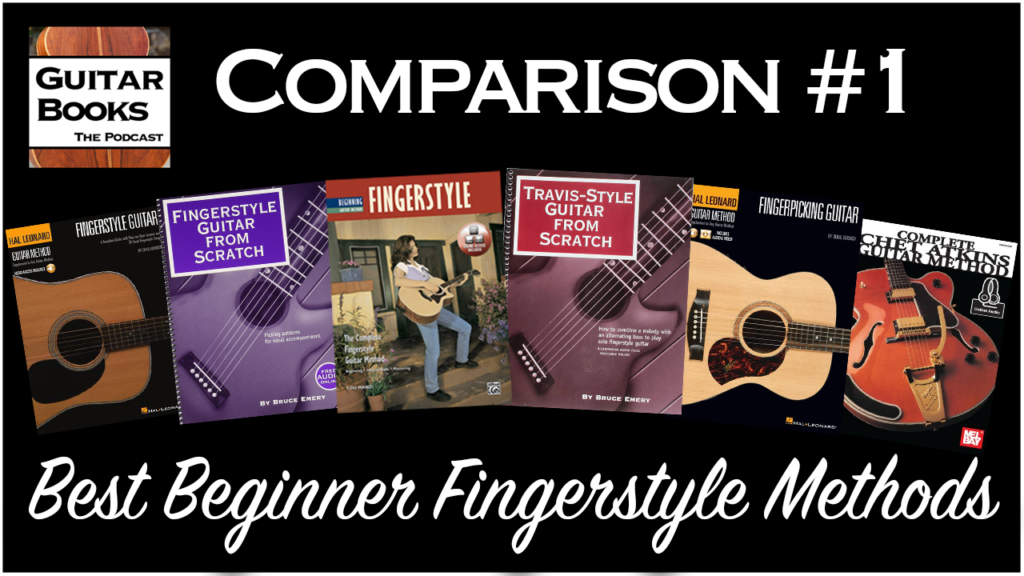
Comparison #1: Best Beginner Fingerstyle Methods

December 2, 2024 by joemcmurray Leave a Comment

https://media.blubrry.com/music_books/content.blubrry.com/music_books/Guitar_Books_Comp_1_Best_Beginner_Methods_2024_12_01.mp3

Podcast: Play in new window | Download (Duration: 18:11 — 25.1MB) | Embed

Subscribe: Apple Podcasts | RSS | More

If you want to get started playing acoustic fingerstyle guitar, you will benefit from private lessons with a teacher, online video courses, listening to fingerstyle recordings, and of course… books.  It is beneficial to mix and match all of these resources.  Remember that everyone’s brain works differently, so you may gravitate more towards certain styles of learning / methods of presentation.  I love learning from books because I can read the text at my own pace and as many times over as I want.  Seeing the music written out is extremely helpful for me – I always had more difficulty keeping track of song forms or chord progressions without some sort of written reference.

So, for those of you who want to utilize a fingerstyle guitar method book to beef up your chops, I’ve done my homework and I’ve distilled my favorites into this “greatest hits” list.  I’ll try to be objective and describe who each book is best suited to.

Best Beginner Fingerstyle Methods:

  1. Alfred’s Beginning Fingerstyle Guitar (Lou Manzi): Great all-around book to learn solo fingerstyle guitar.  Beginner to intermediate.  Not specific to any one subgenre of fingerstyle.  Nice organization/flow of information with a decent difficulty progression.  Good finger exercises to build some dexterity or to use as warmups, decent explanations in the text (but not too wordy), and nice sounding original tunes.  There aren’t any arrangements of famous tunes, but there are tunes “in the style of ___.”  I personally like working through this book with my students.  Additionally, many of this book’s lessons have sparked creative ideas of my own.  First book in a three part series, so you can continue your studies!  Audio recordings are available.
  2. Travis-Style Guitar from Scratch (Bruce Emery): This book is a gem!  This is a method book for learning to play solo fingerstyle guitar using an alternating bass (in the Travis style).  This is one of the best books I’ve found for complete beginner to intermediate players who want to learn this specific style.  Even if you want to play other sub-styles of fingerstyle as well, this isn’t a bad place to start your journey.  The material progresses logically with lots of exercises that build on each other and lead perfectly into performance pieces (old classics like Oh! Susanna, House of the Rising Sun, Jingle Bells, etc.).  Each time Emery presents a new concept, he incorporates it into updated arrangements of each tune.  Emery’s sense of humor is infused into the text of the book, keeping detailed explanations lighthearted and entertaining without losing sight of the important information.  Audio recordings are available.
  3. Fingerstyle Guitar from Scratch (Bruce Emery): I don’t love it as much as Travis-Style Guitar from Scratch, but it is still great general method book.  You will not learn to play solo fingerstyle guitar arrangements (other than a very brief introduction to the topic), but you will receive a great foundation if you are just starting out with fingerstyle.  Complete beginner to intermediate.  Emery’s sense of humor is once again infused into the text of the book, keeping detailed explanations lighthearted and entertaining without losing sight of the important information.  The book is focused on fingerstyle accompaniment using arpeggiation and Travis Style / alternating bass patterns.  This book would make an excellent primer for either Alfred’s Beginning Fingerstyle Guitar or any other fingerstyle guitar method.  Audio recordings are available.
  4. Hal Leonard’s Fingerpicking Guitar (Doug Boduch): Short and sweet method to learn to play accompaniment and solo fingerstyle guitar through famous popular tunes.  Beginner to intermediate.  Guitar teachers may find this book to be a great teaching supplement.  The progression of topics is well laid out, the examples and arrangements are playable and sound good, and the text is concise.  This book is great if you just want to play arrangements of popular tunes, but I’d recommend that you work with a teacher if you want to learn more about how to apply the information outside the book.  Audio recordings are available.  Don’t confuse this with the next book. 
  5. Hal Leonard’s Fingerstyle Guitar (Chad Johnson):  Not to be confused with the previous book, this book is a more in-depth method for learning to play both accompaniment and solo fingerstyle guitar.  Beginner to late-intermediate.  I love the chapter on arranging music for fingerstyle guitar.  There are lots of popular songs – either short samples of the accompaniment parts or full solo instrumental arrangements.  Lots of examples, although they don’t always build on each other very well, creating some tough swings in difficulty.  Audio recordings are available.  I’d recommend Alfred’s Beginning Fingerstyle Guitar over this book unless you specifically want the popular song arrangements.
  6. Mel Bay’s Complete Chet Atkins Guitar Method (Chet Atkins): Excellent method book aimed at beginner and intermediate guitar players who want to learn to play solo fingerstyle guitar arrangements in the style of Chet Atkins (the majority of which utilize an alternating bass/ Travis Style).  If you are interested in this country-blues style of playing that Chet Atkins made popular starting in the 1950s and lasting until his death in 2001, this is a great place to start.  This book ranges in difficulty from easy to intermediate, although a few of the final arrangements are fairly difficult.  This one is moves faster and gets significantly more difficult than Bruce Emery’s Travis-Style Guitar from Scratch.  I’d really recommend going through Emery’s book first and then tackling this one if you are primarily interested in solo Travis Style playing.  This book is arranged much differently from Emery’s book.  Each section focuses on playing in a new key signature, and each new key presents new challenges and new opportunities.  This book also gets you playing up the neck (but don’t be in a rush to play up the neck!).

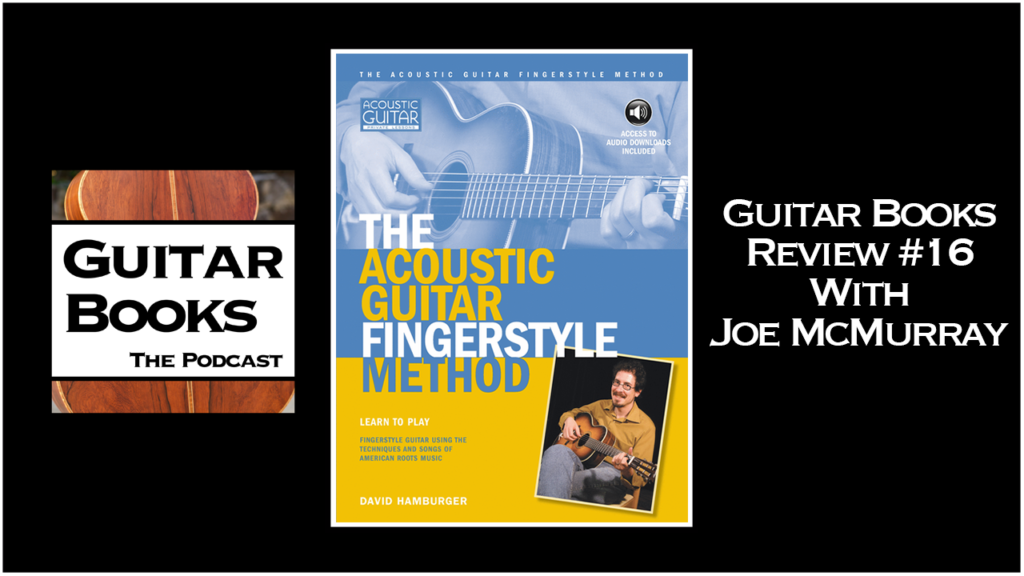
Review #16: Acoustic Guitar Fingerstyle Method by David Hamburger

February 9, 2024 by joemcmurray Leave a Comment

https://media.blubrry.com/music_books/content.blubrry.com/music_books/Guitar_Books_Ep_16_Hamburger_AG_FS_Method_2024_02_08.mp3

Podcast: Play in new window | Download (Duration: 27:47 — 38.3MB) | Embed

Subscribe: Apple Podcasts | RSS | More

Is this one of the best or worst method books for acoustic fingerstyle guitar?

You can learn to play music by simultaneously using a variety of resources including teachers, online resources, and books.

David Hamburger’s The Acoustic Guitar Fingerstyle Method is a method book for learning to play solo fingerstyle (or “fingerpicking”) guitar in the American roots styles (folk, blues, ragtime, early jazz, marches).  The book becomes progressively more difficult – the early sections of the book are appropriate for beginner fingerstyle players who have some experience with open chords and the later sections of the book are more suitable for intermediate players.  Advanced players may still find some useful information, inspiration, or fun repertoire tunes.  This is a well-thought-out book with a great progression of information and fun arrangements of tunes.

The book focuses on alternating bass (Travis picking) arrangements and steady bass arrangements (monotonic bass, walking bass, etc.). There are also brief chapters on Drop D and open D tuning.  The material flows in a sensible progression from chapter to chapter as you build skills and knowledge.  Each chapter includes text and playing examples that directly prepare you for a 1-2 page tune that showcases the techniques or concepts being taught.  The arrangements of the tunes are really nice (they sound good and are playable), although don’t usually include any fingering (there is picking hand fingering notated in the examples, but not the full tunes).  The tunes are stylistically similar to those found in Stefan Grossman’s “Complete Country Blues Guitar Book” and Mel Bay’s “Complete Chet Atkins Guitar Method” although with a very different teaching approach.

The book covers a lot of ground in only 74 pages – from beginning Travis Picking to steady bass blues to harmonized walking bass lines to alternate tunings, etc.  While the examples and tunes are of high quality, there aren’t that many examples for each topic, so you won’t get that deep of an understanding of how to apply some concepts to different situations.  One example of this is playing walking bass lines under your melody- you’ll play a few tunes that include this, but you won’t really learn how to build your own walking bass lines so that you can apply them to your own arrangements or compositions.  However, by the end of the book, you will have a firm grasp of the general approaches of playing using an alternating bass (Travis Picking) or a steady bass.

There is not a lot of music theory in the book.  This may appeal to some readers.  However, it adds to the issue that you may not be able to apply a concept like walking bass lines to other situations.

The text is descriptive and helpful.  However, I don’t like how the publisher places the text as a continuous block at the top of the page with the examples clumped together at the bottom of the page.  Harder for my eyes to jump back and forth.

The author includes great listening recommendations that are relevant to the tunes and topics at hand.

The included audio (2 CDs) provides all examples and tunes played at full speed and slowed down.  The guitar playing is clean and the recording quality is high.

All playing examples are provided in standard notation (treble clef) and tablature.

You could use either a steel string acoustic or nylon string classical guitar to work through this book.  You shouldn’t need to fret any bass notes using your thumb over the top.

Published by String Letter Publishing (publisher of Acoustic Guitar Magazine) © 2007.  Distributed by Hal Leonard.

My eBook: Arranging for Fingerstyle Guitar: go to http://joemcmurray.com/checkout/ to purchase a pdf of my eBook.

My music is available on all streaming platforms:

Pins on the Map: my third fingerstyle guitar album was released on January 19, 2024. Watch the first single, “Open Road,” on YouTube here: https://youtu.be/uPBh8sZQsT4?si=EM_wAwnHFqU1VC9C.

Riding the Wave and Acoustic Oasis: my first two fingerstyle guitar albums.

Review #12: The New Art of Ragtime Guitar by Richard Saslow

October 28, 2023 by joemcmurray Leave a Comment

https://media.blubrry.com/music_books/content.blubrry.com/music_books/Guitar_Books_Ep_12_Saslow_New_Art_of_Ragtime_2023_10_05.mp3

Podcast: Play in new window | Download (Duration: 17:06 — 23.6MB) | Embed

Subscribe: Apple Podcasts | RSS | More

Is this one of the best or worst method books for fingerstyle guitar?

You can learn to play music using a variety of resources including teachers, online resources, and books.

Richard S. Saslow’s The New Art of Ragtime Guitar is a fun, well-graduated repertoire + analysis book for learning to play the fingerpicking guitar style known as ragtime guitar.  It is aimed at intermediate and advanced fingerstyle players, although late beginners can certainly take a stab at the first couple tunes.  The book teaches ragtime guitar through studies of 8 tunes of increasing difficulty.  Each tune is broken down into sections with around 6 measures of the music (treble clef and tablature) on one page and a detailed analysis on the facing page.  Full condensed tunes are in the back of the book.

Out of the author’s eight original tunes, seven are standard sounding ragtime tunes and one is a blues.  Among the ragtime tunes, there is a bit of variation in feel from upbeat and happy to bluesy and minor to jazzy.  There are also several key signatures and some unique harmonizations.  All of the ragtime tunes utilize an alternating bass line as well as some short segments of walking bass line.  The blues tune mainly uses a monotonic bass typical of the Texas blues fingerpicking style.

This is not a method book for learning the basics of fingerstyle guitar in a logical progression from your first notes through to mastery (check out Alfred’s Beginning Fingerstyle, Hal Leonard’s Fingerstyle Guitar, or Mel Bay’s Complete Chet Atkins Guitar Method).  However, there are about 20 pages of introductory text discussing equipment, notation, the ragtime style, and technique.  There is definitely some useful information in this section, especially for novice players.  However, I wouldn’t get too caught up reading this entire section all at once – I would recommend jumping into the tunes which often refer you back to the technique sections of the introduction.  Read the detailed stuff then!

Where the book really excels is in its presentation of the music and its corresponding analysis.  As I mentioned before, for each ragtime tune you will see ~6 measures of music on one page and the detailed analysis on the facing page.  This analysis features detailed directions, techniques, and other tips for the 6 measures at hand.  I usually play through the music once, and then go through the analysis carefully, marking fingerings, anchor fingers, guide fingers, etc. into the music as well as into the condensed version of the tune in the back of the book.  The analysis really does give you insights into how to properly play these tunes (and future tunes from any source) smoothly and musically.

  1. Authentic sounding fingerstyle ragtime tunes.
  2. Good difficulty graduation.
  3. You will spend much more time playing music than analyzing music theory. 
  4. Online recordings of each tune are available.

The book doesn’t get into the modern percussive techniques used by modern players like Michael Hedges, Don Ross, Andy McKee, Mike Dawes, etc.  No thumb slaps, guitar body percussion, or tapping.

I recommend using an acoustic steel string guitar rather than a classical guitar since there are multiple tunes that utilize the fretting hand thumb over the top.

Independently published by the author via Acoustic Truth.  © 2011, 2017 (2nd edition)

eBook: Arranging for Fingerstyle Guitar: go to http://joemcmurray.com/checkout/ to purchase a pdf of my eBook.

Riding the Wave: my second fingerstyle guitar album is available on all streaming platforms.

Pins on the Map: my third fingerstyle guitar album will be released in January 2024. The first single, “Open Road,” was released 10/20/23. Watch it on YouTube here: https://youtu.be/uPBh8sZQsT4?si=EM_wAwnHFqU1VC9C

  • « Go to Previous Page
  • Page 1
  • Page 2
  • Page 3
  • Go to Next Page »

Footer

Website by Erin Girardi

Subscribe to Podcast

Apple PodcastsAndroidby EmailRSSMore Subscribe Options

Copyright © 2026 · Atmosphere Pro on Genesis Framework · WordPress · Log in

  • Music
  • Services
  • Lessons
  • Bio
  • eBooks
  • Guitar Books the Podcast
  • Merch
  • Join the List
  • Weddings
  • Booking / Merch Order Form