• Skip to primary navigation
  • Skip to main content
  • Skip to footer

Joe McMurray Music

Music for any occasion

  • Music
  • Services
  • Lessons
  • Bio
  • eBooks
  • Guitar Books the Podcast
  • Merch
  • Join the List
  • Weddings
  • Booking / Merch Order Form

Podcasts

Review #19: Travis-Style Guitar From Scratch by Bruce Emery

September 23, 2024 by joemcmurray Leave a Comment

https://media.blubrry.com/music_books/content.blubrry.com/music_books/Guitar_Books_Ep_19_Emery_Travis_Style_2024_09_20.mp3

Podcast: Play in new window | Download (Duration: 27:55 — 38.5MB) | Embed

Subscribe: Apple Podcasts | RSS | More

Is this one of the best or worst method books for acoustic fingerstyle guitar?

You can learn to play music by simultaneously using a variety of resources including teachers, online resources, and books.

This book is a gem!  Travis-Style Guitar From Scratch, written by Bruce Emery, is a method book for learning to play solo fingerstyle guitar using an alternating bass (in the Travis style).  This is one of the best books I’ve found for complete beginner to intermediate players who want to learn this style.  The material progresses logically with lots of exercises that build on each other and lead perfectly into performance pieces (old classics like Oh! Susanna, House of the Rising Sun, Jingle Bells, etc.).  Each time Emery presents a new concept, he incorporates it into updated arrangements of each tune.  Emery’s sense of humor is infused into the text of the book, keeping detailed explanations lighthearted and entertaining without losing sight of the important information. 

I can’t overstate how effective this book is with my students.  Emery will present a single idea like how to play an alternating bass line under an A minor chord.  Then he’ll present a series of exercises in which you play a single melody note each measure while maintaining the alternating bass line.  Each exercise will place that melody note on a different beat within the measure.  This approach provides great training that slowly, steadily, and thoroughly develops your physical skills.

The tunes at the beginning of the book couldn’t be more approachable (as solo arrangements), even for beginner students.  The first arrangements don’t feature any syncopation (the melody notes all land on the down beats), making them much easier.  They don’t sound as complex as the later arrangements, but they sound pretty good for beginner students!  This makes it fun and builds confidence.  It is incredibly valuable to see the same tune arranged multiple times with increasing levels of complexity and difficulty.  Aside from getting physically better at playing guitar in this style, you will gain insight into how to add variations to your own arrangements in the future.

No modern tunes in this book.  However, if you work through this book then you’ll be in a much stronger position to approach popular tune arrangements from other sources.

This book is entirely focused on solo Travis-style playing.  You will not learn Travis-style picking patterns that you might use to accompany yourself while singing.  Your guitar will do the singing!  Also, you will not learn other solo fingerstyle approaches like using block chords, arpeggiation, and other modern percussive techniques.

The book focuses on the keys of G major, C major, and A minor.  Three pages at the end are dedicated to the keys of A major, E major, and D major (in drop D tuning).  The book also keeps you playing down in first position (at the nut of the guitar) – no playing up the neck.  This keeps things more approachable.  No complaining here!

Audio recordings are available for all exercises and tunes!  Just go to the author’s website and download.

All playing examples are provided in tablature (TAB) only!!!  Chords are notated above the TAB.  Rhythms are clearly notated.  I enjoy reading standard notation and teach it to interested students, but I don’t personally think much (if anything) is lost by not providing standard notation for this subject matter.

I recommend using an acoustic steel string guitar rather than a standard classical guitar since there are multiple tunes that utilize the fretting hand thumb over the top.

Published in 2006.

My eBook: Arranging for Fingerstyle Guitar: go to http://joemcmurray.com/checkout/ to purchase a pdf of my eBook.  Learning to arrange melodies will also help your fingerstyle songwriting and your understanding of the inner workings of fingerstyle guitar.

My music is available on all streaming platforms at https://open.spotify.com/artist/5dcokTG6C598OhTslHH5uo?si=hrQb7FViSZewDRSgECw9Ew:

Pins on the Map: my third fingerstyle guitar album was released on January 19, 2024. Watch the first single, “Open Road,” on YouTube here: https://youtu.be/uPBh8sZQsT4?si=EM_wAwnHFqU1VC9C.

Riding the Wave and Acoustic Oasis: my first two fingerstyle guitar albums.

Review #18: Alex de Grassi Fingerstyle Guitar Method

July 9, 2024 by joemcmurray Leave a Comment

https://media.blubrry.com/music_books/content.blubrry.com/music_books/Guitar_Books_Ep_18_Alex_de_Grassi_2024_07_08.mp3

Podcast: Play in new window | Download (Duration: 32:33 — 44.9MB) | Embed

Subscribe: Apple Podcasts | RSS | More

Is this one of the best or worst method books for acoustic fingerstyle guitar?

You can learn to play music by simultaneously using a variety of resources including teachers, online resources, and books.

The Alex de Grassi Fingerstyle Guitar Method, written by fingerstyle legend Alex de Grassi and produced by Stringletter (the publisher of Acoustic Guitar Magazine), is a method book for learning to play solo fingerstyle guitar.  You will learn many of the nuts and bolts that bolster de Grassi’s technique, musicality, and general style.  This is an amazing book (a 192 page tome of information!), but it is dense and highly technical.

If you are thinking about investing your time into this book, consider what sub-style of fingerstyle you are interested in.  Listen to Alex de Grassi’s playing to see if that is the direction that you want to go in.  I personally love his playing – he uses a lot of classical technique, he has incredible control and clarity, he is extremely melodic, expressive, and musical, he tastefully uses some modern percussive techniques and cross string ideas, and he plays music that sounds like a blend of folk, Celtic, and blues.  If you want to play like Chet Atkins or Tommy Emmanuel, start with a different book.  If you want to play like Andy McKee, Preston Reed, Don Ross, or Mike Dawes, this book has several very applicable chapters and isn’t a bad stepping stone.  This is a great book if you want to be a well-rounded and precise player.

De Grassi claims that this book is for beginner through advanced players.  The first half of the book certainly contains a lot of “beginner” fingerstyle information, but I highly discourage beginner players from starting with this book as their first foray into fingerstyle guitar.  There are more approachable books with easier arrangements and less text.  If you are a big Alex de Grassi fan and you’re dead set on going through this book as a beginner, it would be helpful to work with a teacher and/or to supplement it with another more beginner-oriented method book (see my other videos/reviews).

I think that this book is very beneficial to a late beginner or intermediate player who can already smoothly play some solo fingerstyle arrangements.  This book will tweak your physical techniques, your tone, and your artistic touch (phrasing, articulation, dynamics, etc.).  

Overall, the 2nd half of the book is very “heady” with many advanced concepts that beginners don’t need to bog themselves down with.  These concepts include difficult cross-string ideas, reasons to use alternate tunings, complex rhythmic ideas (cross-rhythms), modern percussive techniques, and ways to add depth and dimension to your sound.

The repertoire in the book consists of traditional tunes and the author’s original tunes.  There are several full song arrangements, but most of the examples are song fragments.  De Grassi breaks down these fragments in great detail in order to demonstrate the topic being discussed in the text.

There is SO much detail in the descriptions.  He gets into the nuances of how to physically perform a technique, where to place your fingers, how to control note durations, etc.   The text is very dense, and it took me a long, long time to get through it.  I recommend listening to each (wonderful) audio example, then reading the text pertaining to that example, and then playing that example.  You will likely need to repeat this process multiple times for each example or topic.

The audio recordings are invaluable for hearing the artistic details, ornamentation, and complex rhythms of the examples.  I don’t think I’ve ever been so tied to the audio recordings of a method book.

All playing examples are provided in standard notation (treble clef) and tablature.

You could use either a steel string acoustic or nylon string classical guitar to work through this book.  You don’t have to fret any bass notes using your thumb over the top (although I like to here and there).

Published in 2012.

My eBook: Arranging for Fingerstyle Guitar: go to http://joemcmurray.com/checkout/ to purchase a pdf of my eBook.  Learning to arrange melodies will also help your fingerstyle songwriting and your understanding of the inner workings of fingerstyle guitar.

My music is available on all streaming platforms at https://open.spotify.com/artist/5dcokTG6C598OhTslHH5uo?si=hrQb7FViSZewDRSgECw9Ew:

Pins on the Map: my third fingerstyle guitar album was released on January 19, 2024. Watch the first single, “Open Road,” on YouTube here: https://youtu.be/uPBh8sZQsT4?si=EM_wAwnHFqU1VC9C.

Riding the Wave and Acoustic Oasis: my first two fingerstyle guitar albums.
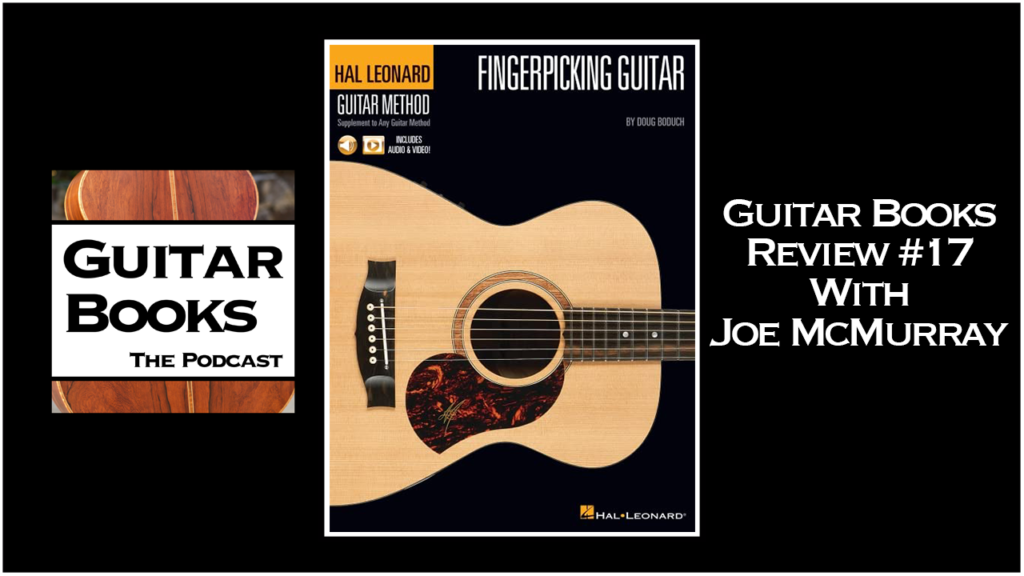
Review #17: Hal Leonard Fingerpicking Guitar

March 2, 2024 by joemcmurray Leave a Comment

https://media.blubrry.com/music_books/content.blubrry.com/music_books/Guitar_Books_Ep_17_Hal_Leonard_Fingerpicking_Guitar_2024_03_01.mp3

Podcast: Play in new window | Download (Duration: 26:31 — 36.6MB) | Embed

Subscribe: Apple Podcasts | RSS | More

Is this one of the best or worst method books for acoustic fingerstyle guitar?

You can learn to play music by simultaneously using a variety of resources including teachers, online resources, and books.

Hal Leonard’s Fingerpicking Guitar, written by Doug Boduch, is a method book for learning to play solo fingerstyle (or “fingerpicking”) guitar or fingerstyle guitar accompaniment.  The book features lots of popular tunes (the Beatles, Adele, Sam Smith, Imagine Dragons, The Police, Toto, Ed Sheeran, etc.).  Overall, It is suitable for beginner through intermediate players with the tunes in the later sections of the book becoming progressively more difficult up to that intermediate skill level.  Advanced players may still find some fun repertoire tunes.  Guitar teachers may find this book to be a great teaching supplement.  The progression of topics is well laid out, the examples and arrangements are playable and sound good, and the text is concise. 

The book is very short at 38 pages.  This is partially due to a lack of detailed explanations, which is part of why this book may work better as a supplement to private lessons or to another more detailed method book.  The book is also short because it just doesn’t have that many examples.  The examples and arrangements are of high quality, but they don’t cover the many nuances that could pop up in the world of fingerstyle guitar.

If you are looking to play solo fingerstyle guitar arrangements of popular/modern tunes, then this book may be for you.  If you are looking for folk, blues, ragtime, Celtic, or classical music, then there are better options.

Fingerpicking Guitar starts with examples of playing easy single-line melodies (Happy Birthday, etc.) with your fingers or thumb.  The book then presents some arrangements that utilize a single, easy-to-grab bass note underneath the melody in each measure.  Later on it focuses on arrangements that feature alternating bass lines (Travis picking).  The book provides some basic arpeggiation examples for accompaniment as well as some arrangements that utilize arpeggiation, but it doesn’t really provide much detail about how to apply arpeggiation underneath a melody in a solo arrangement.  There is no discussion of more complex techniques (natural and artificial harmonics, harmonizing melodies with 3rds, 6ths, etc.), alternate tunings, or more modern percussive techniques.

Don’t confuse this book with Hal Leonard’s Fingerstyle Guitar by Chad Johnson.  There is a similar progression of information, but they are different books.  The older Fingerstyle Guitar also features popular tunes, but is overall lengthier and more detailed.  However, I prefer some of the arrangements in the newer Fingerpicking Guitar, especially for my guitar students.

There is virtually ZERO music theory in Fingerstyle Guitar.  This may appeal to some readers.  However, you won’t learn how to apply the concepts/techniques presented into other musical situations (other tunes, etc.).  With the help of a teacher or another book you could get a lot more out of Fingerpicking Guitar.

The book includes access to online audio or video for every example.  The audio can be slowed down which can be very helpful.  The guitar playing is clean and the recording quality is high.  Example numbers don’t line up between Example 30 and 33, but they are all there.

All playing examples are provided in standard notation (treble clef) and tablature.

You could use either a steel string acoustic or nylon string classical guitar to work through this book.  You don’t have to fret any bass notes using your thumb over the top (although I like to here and there).

Published by Hal Leonard © 2023.

My eBook: Arranging for Fingerstyle Guitar: go to http://joemcmurray.com/checkout/ to purchase a pdf of my eBook.  Learning to arrange melodies will also help your fingerstyle songwriting and your understanding of the inner workings of fingerstyle guitar.

My music is available on all streaming platforms: https://open.spotify.com/artist/5dcokTG6C598OhTslHH5uo?si=hrQb7FViSZewDRSgECw9Ew:

Pins on the Map: my third fingerstyle guitar album was released on January 19, 2024. Watch the first single, “Open Road,” on YouTube here: https://youtu.be/uPBh8sZQsT4?si=EM_wAwnHFqU1VC9C.

Riding the Wave and Acoustic Oasis: my first two fingerstyle guitar albums.

Review #16: Acoustic Guitar Fingerstyle Method by David Hamburger

February 9, 2024 by joemcmurray Leave a Comment

https://media.blubrry.com/music_books/content.blubrry.com/music_books/Guitar_Books_Ep_16_Hamburger_AG_FS_Method_2024_02_08.mp3

Podcast: Play in new window | Download (Duration: 27:47 — 38.3MB) | Embed

Subscribe: Apple Podcasts | RSS | More

Is this one of the best or worst method books for acoustic fingerstyle guitar?

You can learn to play music by simultaneously using a variety of resources including teachers, online resources, and books.

David Hamburger’s The Acoustic Guitar Fingerstyle Method is a method book for learning to play solo fingerstyle (or “fingerpicking”) guitar in the American roots styles (folk, blues, ragtime, early jazz, marches).  The book becomes progressively more difficult – the early sections of the book are appropriate for beginner fingerstyle players who have some experience with open chords and the later sections of the book are more suitable for intermediate players.  Advanced players may still find some useful information, inspiration, or fun repertoire tunes.  This is a well-thought-out book with a great progression of information and fun arrangements of tunes.

The book focuses on alternating bass (Travis picking) arrangements and steady bass arrangements (monotonic bass, walking bass, etc.). There are also brief chapters on Drop D and open D tuning.  The material flows in a sensible progression from chapter to chapter as you build skills and knowledge.  Each chapter includes text and playing examples that directly prepare you for a 1-2 page tune that showcases the techniques or concepts being taught.  The arrangements of the tunes are really nice (they sound good and are playable), although don’t usually include any fingering (there is picking hand fingering notated in the examples, but not the full tunes).  The tunes are stylistically similar to those found in Stefan Grossman’s “Complete Country Blues Guitar Book” and Mel Bay’s “Complete Chet Atkins Guitar Method” although with a very different teaching approach.

The book covers a lot of ground in only 74 pages – from beginning Travis Picking to steady bass blues to harmonized walking bass lines to alternate tunings, etc.  While the examples and tunes are of high quality, there aren’t that many examples for each topic, so you won’t get that deep of an understanding of how to apply some concepts to different situations.  One example of this is playing walking bass lines under your melody- you’ll play a few tunes that include this, but you won’t really learn how to build your own walking bass lines so that you can apply them to your own arrangements or compositions.  However, by the end of the book, you will have a firm grasp of the general approaches of playing using an alternating bass (Travis Picking) or a steady bass.

There is not a lot of music theory in the book.  This may appeal to some readers.  However, it adds to the issue that you may not be able to apply a concept like walking bass lines to other situations.

The text is descriptive and helpful.  However, I don’t like how the publisher places the text as a continuous block at the top of the page with the examples clumped together at the bottom of the page.  Harder for my eyes to jump back and forth.

The author includes great listening recommendations that are relevant to the tunes and topics at hand.

The included audio (2 CDs) provides all examples and tunes played at full speed and slowed down.  The guitar playing is clean and the recording quality is high.

All playing examples are provided in standard notation (treble clef) and tablature.

You could use either a steel string acoustic or nylon string classical guitar to work through this book.  You shouldn’t need to fret any bass notes using your thumb over the top.

Published by String Letter Publishing (publisher of Acoustic Guitar Magazine) © 2007.  Distributed by Hal Leonard.

My eBook: Arranging for Fingerstyle Guitar: go to http://joemcmurray.com/checkout/ to purchase a pdf of my eBook.

My music is available on all streaming platforms:

Pins on the Map: my third fingerstyle guitar album was released on January 19, 2024. Watch the first single, “Open Road,” on YouTube here: https://youtu.be/uPBh8sZQsT4?si=EM_wAwnHFqU1VC9C.

Riding the Wave and Acoustic Oasis: my first two fingerstyle guitar albums.

Review #15: Fingerstyle 101 by Dan Thorpe

January 12, 2024 by joemcmurray Leave a Comment

https://media.blubrry.com/music_books/content.blubrry.com/music_books/Guitar_Books_Ep_15_Thorpe_Fingerstyle_101_2024_01_11.mp3

Podcast: Play in new window | Download (Duration: 20:59 — 28.9MB) | Embed

Subscribe: Apple Podcasts | RSS | More

Is this one of the best or worst method books for fingerstyle guitar?

You can learn to play music by simultaneously using a variety of resources including teachers, online resources, and books.

Dan Thorpe’s Fingerstyle 101 is a method book for learning to play fingerstyle (or “fingerpicking”) guitar.  The book is appropriate for absolute beginner fingerstyle players who have some experience with open chords.  Intermediate and advanced players will fly through this book and may find a few useful ideas but probably won’t find any revelatory information or inspiring performance pieces.  The author has written this book with older adult students in mind, although any beginning students would certainly benefit from working through it.  The book contains lots of practical advice on fingerpicking technique, playing posture, and strategies for practicing and memorization.  It has sections including “Pro Tips to Make Your Fingerpicking Journey Easier and More Enjoyable,” “The 7 Most Deadly Fingerpicking Mistakes,” and “The 10 Steps for Getting the Most Out of Your Fingerpicking Playing.”  There is one section of the book (less than half the book) with actual playing examples, and these examples are great first fingerpicking patterns to learn along with some practical applications.

There is lots of text in the book.  Fortunately, this text is informative without being bland.  Lots of lists, summaries, pictures, etc.  The text has a large font size so it is easy on the eyes.  Thorpe provides advice for avoiding guitar-related injuries – i.e. information about how to hold the guitar in the classical style to help older students avoid back pain.  There is some psychology about how to learn efficiently/effectively and how to make and set goals.  There is a chord reference guide as well as sections on understanding basic rhythms and reading tablature (TAB).

The playing section in the middle of the book progresses at a reasonable pace for a beginner fingerstyle student.  Thorpe teaches ten fingerpicking patterns, and for each pattern there are three examples.  The first example is as basic as possible over a single chord shape.  The second example has you play the pattern over a simple chord progression (always C G D).  Since you always utilize the same C G D chord progression, you will be able to focus your brain power on your picking hand and the new pattern.  This is also very practical because if you want to fingerpick the guitar while singing, it is useful to try out a pattern over simple chord progressions that you might find in folk or pop songs.  Finally, the third example introduces a more complex chord progression, stylistic elements such as hammer-ons and pull-offs, and sometimes a (very simple) moving melody or bass line.  These third examples are not long enough to be performance pieces, but they may inspire you to add some flair to your accompaniment fingerpicking or to write your own compositions.

The book doesn’t progress far enough to establish a specific style within the umbrella of fingerstyle guitar.  You learn a few classical arpeggiation patterns, a few Travis picking patterns, and a few patterns that have some folk or blues flair.  The book doesn’t get into the modern percussive techniques used by modern players like Michael Hedges, Don Ross, Andy McKee, Mike Dawes, etc.  No thumb slaps, guitar body percussion, or tapping.

All playing examples are provided in standard notation (treble clef) and tablature.  Audio recordings are available for all playing examples.

You could use either a steel string or nylon string classical guitar to work through this book.

Published by Rockstar Publishing  © 2015, 2020.  Distributed by Hal Leonard.

My eBook: Arranging for Fingerstyle Guitar: go to http://joemcmurray.com/checkout/ to purchase a pdf of my eBook.

My music is available on all streaming platforms:

Pins on the Map: my third fingerstyle guitar album will be released on January 19, 2024. The first single, “Open Road,” was released 10/20/23. Watch it on YouTube here: https://youtu.be/uPBh8sZQsT4?si=EM_wAwnHFqU1VC9C.  Three other singles have since been released: “Lost and Found,” “The Matador,” and “Pins on the Map.”

Riding the Wave and Acoustic Oasis: my first two fingerstyle guitar albums.

Review #14: Christmas Repertoire Books for Solo Fingerstyle Guitar

December 1, 2023 by joemcmurray Leave a Comment

https://media.blubrry.com/music_books/content.blubrry.com/music_books/Guitar_Books_Ep_14_Christmas_Repertoire_for_Solo_Fingerstyle_Guitar_2023_11_30.mp3

Podcast: Play in new window | Download (Duration: 32:42 — 45.0MB) | Embed

Subscribe: Apple Podcasts | RSS | More

Christmas repertoire books featuring solo fingerstyle guitar arrangements are great for the holiday season!  Whether you simply want to get into the Christmas spirit or you need to perform Christmas tunes at your gigs, there are a number of great Christmas repertoire books.  In this review I will look at three books that I really enjoy: Hal Leonard’s “Fingerpicking Yuletide,” Mark Phillips’ “Christmas Carols for Easy Classical Guitar” (Cherry Lane Music Company), and John Hill’s “Classical Guitar Christmas Sheet Music” (Hal Leonard).

To be clear, all books are suitable for either steel string guitar or nylon string classical guitar.

All three books feature a range of tunes suitable for late-beginner through intermediate fingerstyle guitarists.  Hal Leonard’s “Fingerpicking Yuletide” features mid-twentieth century tunes like Frosty the Snowman, Jingle Bell Rock, and Let It Snow! Let It Snow! Let It Snow!  Phillips’ “Christmas Carols for Easy Classical Guitar” and Hill’s “Classical Guitar Christmas Sheet Music” both feature traditional Christmas carols like O Come, All Ye Faithful, The First Noel, Jingle Bells, and Silent Night.

Hal Leonard’s “Fingerpicking Yuletide” and Phillips’ “Christmas Carols for Easy Classical Guitar” provide both standard notation and tablature, but Hill’s “Classical Guitar Christmas Sheet Music” provides only standard notation (no TAB!!!).

The arrangements in Phillips’ “Christmas Carols for Easy Classical Guitar” flow really well with nice arpeggiation.  The arrangements in Hill’s “Classical Guitar Christmas Sheet Music” are a mixed bag, but many of them have nice arpeggiation or feature an alternating bass line (Travis picking).  Some of the arrangements are a bit clunky in comparison to the Phillips book.  The arrangements in Hal Leonard’s “Fingerpicking Yuletide” are also a mixed bag, but tend to be a little stripped down/simplified to make them easier.  While some are great as they are, some are a little uninspiring until you add some extra inner harmony, arpeggiation, or other pizzazz.  The arrangements are great for late-beginner/intermediate players, and they are excellent skeletons/frameworks/starting points from which more advanced players can add extra spice.  The arrangements utilize a variety of alternating bass lines and arpeggiation.

Hal Leonard’s “Fingerpicking Yuletide” has 16 tunes.  Phillips’ “Christmas Carols for Easy Classical Guitar” has 22 tunes.  Hill’s “Classical Guitar Christmas Sheet Music” has 30 tunes.

Hal Leonard’s “Fingerpicking Yuletide” is the only book out of the three that has the lyrics written into the music which is nice when playing with friends/family or for helping you to sing the melody out loud or in your head while you are playing solo.

Phillips’ “Christmas Carols for Easy Classical Guitar” is the only book out of the three that comes with recordings of the tunes (mine came with a CD).

All three books are worth buying – it just depends on what you’re looking for.

My eBook: Arranging for Fingerstyle Guitar: go to http://joemcmurray.com/checkout/ to purchase a pdf of my eBook.

My music is available on all streaming platforms:

Pins on the Map: my third fingerstyle guitar album will be released in January 2024. The first single, “Open Road,” was released 10/20/23. Watch it on YouTube here: https://youtu.be/uPBh8sZQsT4?si=EM_wAwnHFqU1VC9C.  Three other singles have since been released: “Lost and Found,” “The Matador,” and “Pins on the Map.”

Riding the Wave and Acoustic Oasis: my first two fingerstyle guitar albums.

  • « Go to Previous Page
  • Page 1
  • Page 2
  • Page 3
  • Page 4
  • Page 5
  • Page 6
  • Go to Next Page »

Footer

Website by Erin Girardi

Subscribe to Podcast

Apple PodcastsAndroidby EmailRSSMore Subscribe Options

Copyright © 2026 · Atmosphere Pro on Genesis Framework · WordPress · Log in

  • Music
  • Services
  • Lessons
  • Bio
  • eBooks
  • Guitar Books the Podcast
  • Merch
  • Join the List
  • Weddings
  • Booking / Merch Order Form