• Skip to primary navigation
  • Skip to main content
  • Skip to footer

Joe McMurray Music

Music for any occasion

  • Music
  • Services
  • Lessons
  • Bio
  • eBooks
  • Guitar Books the Podcast
  • Merch
  • Join the List
  • Weddings
  • Booking / Merch Order Form

Comparisons

Comparison #3: Best Fingerstyle Blues Repertoire Books

March 3, 2026 by joemcmurray Leave a Comment

https://media.blubrry.com/music_books/content.blubrry.com/music_books/Guitar_Books_Comp_3_Best_FS_Blues_Rep_2026_02_24.mp3

Podcast: Play in new window | Download (Duration: 7:58 — 11.1MB) | Embed

Subscribe: Apple Podcasts | RSS | More

Looking to learn new fingerstyle blues tunes to play on your acoustic guitar?  This is a rundown of my favorite fingerstyle blues repertoire books.

Hopefully you have already seen my previous video of “Best Fingerstyle Blues Method Books.”  Method books provide a guided course of study with explanatory text, exercises, example tune arrangements, etc.  In this video I will be talking about my favorite fingerstyle blues repertoire books, which simply provide tune arrangements and possibly some background info for each tune.

I’ve been through many, many books, and I have been teaching and performing professionally for over a decade, so hopefully my insights can help guide you to the book that is best for you!

Be aware that all of these repertoire books provide standard notation and tablature, and most of them do NOT provide any picking or fretting hand fingering.  Working out optimal fingering is extremely important when learning an arrangement – good fingering choices make playing easier and minimize the potential for mistakes.

Best Repertoire Books

1) The Complete Acoustic Blues Guitar Method (Mann, 2014)

Repertoire book that presents lots of tunes from across the many subgenres of fingerstyle blues.  These are solid arrangements that occasionally provide multiple choruses to show variations- this is extremely valuable for extending short tunes into performance length pieces.  It is also worth analyzing the author’s variations so that you can learn to create your own!

Late beginner to advanced, but majority of the tunes are of an intermediate difficulty.

I really like the organization of the book: tunes are organized by subgenre, and within each section the tunes are arranged from easiest to hardest. 

Each tune comes with nice historical background info and listening recommendations.

2) 12-Bar Fingerstyle Blues (Rubin, 2012)

Repertoire book.

Mostly intermediate.

More repetitive grooves than some of the other fingerstyle blues books on the market.  Fewer lyrical phrases in the melodies. 

I like that the tunes organized by subgenre, but the difficulty jumps around from tune to tune.

For experienced players, this is a fast book to work through.  Because each tune is a 12-bar chorus, you will get a lot of ideas that you can digest, combine, and make your own in the future.

Next, I want to introduce a special book that doesn’t quite fit into the simple “Repertoire Book” category:

3) The New Art of Ragtime Guitar (Saslow, 2011, 2017 2nd Ed.)

This book is essentially a repertoire book of ragtime blues tunes, but the analysis that accompanies each tune is extensive and extremely valuable.

Late beginner to advanced and difficulty progresses with each tune.

These tunes are really fun, and you will gain valuable insight from the analysis.  The author coaches you through fingering choices, his use of guide, anchor, or pivot fingers, etc.  These lessons will make you a better player.

4) Fingerstyle Blues Songbook (James, 2005)

Another repertoire book with good arrangements and historical background info.

Honestly, it’s not all that much different from Woody Mann’s The Complete Acoustic Blues Guitar Method, but this book is much shorter.

Late-beginner to intermediate, although advanced players will certainly enjoy the tunes as well.

5) Complete Country Blues Guitar Book (Grossman, 1992)

Repertoire book.  Good arrangements.  Lots of authentic tunes.

Stefan Grossman is an incredible musicologist who helped rediscover and promote much of the old fingerstyle blues music of the 1920s and 30s.  I really like the interviews and historical information that he has included making this a great coffee table book.

Late-beginner to intermediate.

Tunes organized by subgenre.

Strange TAB.

*6) Solo Blues Guitar (Rubin, 2006)

Repertoire – I’m putting this book at the end because it is NOT a fingerstyle blues guitar book.  The examples can be played fingerstyle, but most seem to work best with a plectrum/pick/flatpick.  However, I want to include this book for a couple reasons:

  1. It is focused on solo blues guitar arrangements
  2. I LOVE this book.  These examples are fun and they inspire me to improvise in new ways with new grooves.

Like Rubin’s 12-Bar Fingerstyle Blues, these tunes also feature repetitive grooves alternating with melodic lines and licks, rather than choruses focused on lyrical melodies.

My own books:

Fingerstyle Blues Guitar: An In-Depth Study of the 12-Bar Blues in E Major – Books 1 and 2 are available in paperback or eBook through Amazon [https://a.co/d/g7Udsso (Book 1) and https://a.co/d/aDbh4H0 (Book 2)]. The first priority of these books is to quickly get you playing a solo instrumental 12-bar blues, & then to build on it until you can freely improvise or “jam.” You should be up and running by the end of the third chapter, and each following chapter will add icing on the cake.

Arranging for Fingerstyle Guitar: go to http://joemcmurray.com/checkout/ to purchase a pdf of my eBook.

Arranging for Fingerstyle Ukulele, will be published by Mel Bay in 2026.

My music is available on all streaming platforms at https://open.spotify.com/artist/5dcokTG6C598OhTslHH5uo?si=hrQb7FViSZewDRSgECw9Ew:

Pins on the Map: my third fingerstyle guitar album was released on January 19, 2024. Watch the first single, “Open Road,” on YouTube here: https://youtu.be/uPBh8sZQsT4?si=EM_wAwnHFqU1VC9C.

Riding the Wave and Acoustic Oasis: my first two fingerstyle guitar albums.

Comparison #2: Best Fingerstyle Blues Method Books

February 20, 2026 by joemcmurray Leave a Comment

https://media.blubrry.com/music_books/content.blubrry.com/music_books/Guitar_Books_Comp_2_Best_FS_Blues_Methods_2026_02_11.mp3

Podcast: Play in new window | Download (Duration: 15:12 — 21.0MB) | Embed

Subscribe: Apple Podcasts | RSS | More

If you want to get started playing fingerstyle guitar, you will benefit from private lessons with a teacher, online video courses, listening to fingerstyle recordings, and of course… books.  It is beneficial to mix and match all of these resources.  Remember that everyone’s brain works differently, so you may gravitate more toward certain styles of learning / methods of presentation.  I love learning from books because I can read the text at my own pace and as many times over as I want.  Seeing the music written out is extremely helpful for me – I always had more difficulty keeping track of song forms or chord progressions without some sort of written reference.

So, for those of you who want to utilize a fingerstyle blues book to beef up your chops, I’ve done my homework and I’ve distilled my favorites into this “greatest hits” list.  I’ll try to be objective and describe who each book is best suited to.  Additionally, I’ll separate things out and first tell you about my favorite method books and then my favorite repertoire books.

Method Books

Guided course of study with explanatory text, exercises, example tune arrangements, etc.

Repertoire Books

Tune arrangements and possibly some background info for each tune.

Method Books

** Travis-Style Guitar From Scratch (Emery, 2006)

My all-time favorite book for learning to play solo fingerstyle guitar with an alternating bass or “Travis-style”, which is used in much fingerstyle blues playing. 

Beginnner to intermediate. 

Lots and lots of exercises, smooth difficulty progression, repeated tunes at increasing difficulty levels, text with a sense of humor.

* Fingerstyle Guitar From Scratch (Emery, 2003)

Great for absolute beginner guitar players looking to step into the world of fingerstyle guitar. 

More focused on fingerstyle accompaniment or backup rather than solo fingerstyle guitar.

Now on to my favorite method books that are focused on fingerstyle blues.

1) Acoustic Guitar Fingerstyle Method (Hamburger, 2007)

Method book – could be the best initial book to work through if you’re just getting started with fingerstyle blues or fingerstyle in general.  Effective organization of topics, progressive exercises, short but fun song arrangements at the end of each chapter.

Primarily aimed at beginner to intermediate, but some of the final chapters are fairly difficult.

Overall, this book provides a great overview of the techniques and approaches used in fingerstyle blues, giving you a solid foundation.

After working through this book, you could move on to any of the other method or repertoire books that I’m about to introduce, where you can refine your skills and technique, learn to improvise, and learn more tunes.

2) Fingerstyle Blues Guitar: An In-Depth Study of the 12-Bar Blues in the Key of E Major: Books 1 & 2

It is without shame that I present my own books.

These method books are focused on lyrical improvisation over monotonic bass.

  • First priority of these books is to quickly get you playing a solo instrumental 12-bar blues in the key of E major, and then to build on it until you can freely improvise or jam.
  • You should be up and running by the end of the 3rd chapter, and each subsequent chapter will add icing to your cake.
  • Organized the books so that the concepts and exercises progress logically, thoroughly, and with a smooth difficulty progression.
    • Take care to explain how to immediately apply each concept to your playing.
  • These are essentially one long book split down the middle: Book 2 picks up right where Book 1 left off.  It was just too long – it would have been around 350 pages.
  • I recommend that everyone start with Book 1, which is suitable for all skill levels.
    • Complete beginner players who work through the first few chapters should be able to improvise a satisfying fingerstyle blues solo.
    • Intermediate to advanced players will breeze through the first few chapters, but will hopefully pick up some useful information starting around Chapter 4.
  • Book 2 is more suitable for intermediate to advanced players.
    • It digs deeper into higher level concepts that are more technically and theoretically difficult, but will elevate your playing to new levels.
    • You will learn to play new scales, turnarounds, rhythms, time signatures, key signatures, and more!
  • Again, I recommend that everyone start with Book 1, and then move on to Book 2.
  • When comparing my books to other fingerstyle blues books on the market, most other books focus on playing the blues over an alternating or Travis-style bassline, although they may present some material on using a monotonic bassline.
  • One other book, which, SPOILER, happens to be the next on my list, focuses on playing the blues over a monotonic bassline – Joseph Alexander’s Fingerstyle Blues Guitar.
    • I was honestly very influenced by this book, and I highly recommend it in addition to mine!
    • However, Alexander’s book focuses more on teaching you a bunch of authentic blues language and licks over the monotonic bassline, with less emphasis on putting together a full lyrical 12-bar solo, nonetheless a full multi-chorus performance.  In my books, I actually provide lyrics to help guide the spontaneous creation of melodies.
    • My book starts from a more beginner-friendly place and builds with a much more gradual difficulty progression.  Easier melodies and rhythms at first, with many, many examples.
    • My book also focuses on the bigger picture of putting together a cohesive blues chorus and then a cohesive multi-chorus performance.
  • One other aspect about my book that is very valuable is that I have provided both fretting and picking hand fingering throughout every example.  Optimal fingering is extremely important when learning an arrangement – good fingering choices make playing easier and minimize the potential for mistakes.
  • I have spent a lot of time working through other books, I have real world experience, and I’ve tried to create a series of books that will be most effective at teaching you to actually jam on the blues.

Now, a downside for many of you will be that I can’t currently offer audio recordings (I have 2 little kids and life is incredibly busy!), but I can email you the GuitarPro files for every example if that would be helpful.  I’m also happy to send out videos of specific examples if you reach out. joemcmurrayguitar@gmail.com

Available thru Amazon [https://a.co/d/g7Udsso (Book 1) and https://a.co/d/aDbh4H0 (Book 2)]

3) Fingerstyle Blues Guitar (Alexander, 2015)

Method book, focused on improvisation and licks over monotonic bass.

Late beginner to advanced, like my books, but it is best for intermediate.  It’s honestly a great companion to my books!

Lots of great licks and blues phrases, but not as much explanation about how to apply these phrases into a cohesive blues chorus or multi-chorus performance.

My advice is that you take each phrase from the book and incorporate it into a 12-bar blues.  Then spend time improvising your own similar blues phrases over the 12-bar blues.

Overall, if you want to learn to improvise over the blues using a monotonic bassline, there is a wealth of valuable information in this book, and it takes a wonderful approach, but I think that I have filled in some gaps with my own books.

4) Beginning Fingerstyle Blues Guitar (Berle / Galbo, 1993)

Method book.  Does a good job starting from the basics and providing exercises that progress gradually and logically.  Almost entirely focused on playing the blues with an alternating or Travis-Style bassline.

Beginner players who can play basic chords through to intermediate players.  

This is the first fingerstyle blues book that I’ve come across that provides a great chapter on how to incorporate singing over your guitar playing.

Overall, a very solid purchase if you are a beginner looking to learn to play traditional fingerstyle blues with an alternating bassline.

5) Rainer’s Acoustic Blues Guitar Picking School (Brunn, 2022)

Method book, but minimal text and fairly short book overall.  Valuable info and exercises, but less comprehensive.

Late beginner to intermediate

You will gain important technical/physical skills to play fingerstyle blues, but there isn’t much explanation on how to approach a new blues tune, there’s not much music theory to help you choose the proper notes while improvising, etc.

Overall, I really enjoyed this book.  It gave me good workouts and I got some new ideas.

6) Fingerstyle Blues (Rivera, 2020)

Inspiring, well-graduated method book for learning to play fingerstyle blues.

However, this is for intermediate to advanced fingerstyle players. 

Each chapter ultimately provides a full performance tune, but starts by describing a new concept or technique (or two) and providing examples that prepare you for the performance song.

Overall, this book has some really cool tunes and ideas, but to be clear, I would not recommend approaching this book until you’ve worked through at least one of the other books that I’ve already mentioned.  You will get more out of this one if you are adequately prepared.

7) Roots and Blues Fingerstyle Guitar Explorations (James, 2014)

Last on my list is actually a hybrid repertoire/method book, Roots and Blues Fingerstyle Guitar Explorations (James, 2014).

I call this a hybrid repertoire/method book because it is mostly a collection of tunes, but with a few exercises and extra technical explanations and historical anecdotes.

Again, this is a book for learning to play fingerstyle and bottleneck blues. 

Late beginner to advanced fingerstyle players but is best for intermediate players.

This is at the bottom of my list here, but it is good for learning open tunings and how to play fingerstyle blues using a slide.

Before we go, I want to introduce another special book that doesn’t quite fit into the “Method Book” category:

* The New Art of Ragtime Guitar (Saslow, 2011, 2017 2nd Ed.)

This book is essentially a repertoire book of ragtime blues tunes, but the analysis that accompanies each tune is extensive and extremely valuable.

Late beginner to advanced and difficulty progresses with each tune.

These tunes are really fun, and you will gain valuable insight from the analysis.  The author coaches you through fingering choices, his use of guide, anchor, or pivot fingers, etc.  These lessons will make you a better player.

My own books:

Fingerstyle Blues Guitar: An In-Depth Study of the 12-Bar Blues in E Major – Books 1 and 2 are available in paperback or eBook through Amazon [https://a.co/d/g7Udsso (Book 1) and https://a.co/d/aDbh4H0 (Book 2)]. The first priority of these books is to quickly get you playing a solo instrumental 12-bar blues, & then to build on it until you can freely improvise or “jam.” You should be up and running by the end of the third chapter, and each following chapter will add icing on the cake.

Arranging for Fingerstyle Guitar: go to http://joemcmurray.com/checkout/ to purchase a pdf of my eBook.

Arranging for Fingerstyle Ukulele, will be published by Mel Bay in 2026.

My music is available on all streaming platforms at https://open.spotify.com/artist/5dcokTG6C598OhTslHH5uo?si=hrQb7FViSZewDRSgECw9Ew:

Pins on the Map: my third fingerstyle guitar album was released on January 19, 2024. Watch the first single, “Open Road,” on YouTube here: https://youtu.be/uPBh8sZQsT4?si=EM_wAwnHFqU1VC9C.

Riding the Wave and Acoustic Oasis: my first two fingerstyle guitar albums.

Review #25: Christmas Rep for Solo Fingerstyle Guitar, 2025 Update

December 1, 2025 by joemcmurray Leave a Comment

https://media.blubrry.com/music_books/content.blubrry.com/music_books/Guitar_Books_Ep_25_Christmas_Books_2025_2025_11_18.mp3

Podcast: Play in new window | Download (Duration: 24:33 — 33.9MB) | Embed

Subscribe: Apple Podcasts | RSS | More

Christmas repertoire books featuring solo fingerstyle guitar arrangements are great for the holiday season!  Whether you simply want to get into the Christmas spirit or you need to perform Christmas tunes at your gigs, there are a number of great Christmas repertoire books.  Last year I did a similar multi-book review, but I need to put out an update since I have since gone on a buying spree and purchased 4 more books that I’d been curious about.  In this review I will look at the original three books that I reviewed:

  • Hal Leonard’s “Fingerpicking Yuletide,”
  • Mark Phillips’ “Christmas Carols for Easy Classical Guitar” (Cherry Lane Music Company), and
  • John Hill’s “Classical Guitar Christmas Sheet Music” (Hal Leonard)

As well as my four new books:

  • Michael Wood’s “Echoes of Christmas Past,”
  • Bruce Emery’s “Christmas Fingerstyle Guitar,” and
  • Doug Young’s “Christmas Carols for Fingerstyle Guitar” AND “A DADGAD Christmas.”

And finally I’ll mention one book that I don’t have, but I can see enough from previews to be able to compare to the other books:

  • Hal Leonard’s “Fingerpicking Christmas”

To be clear, all books are suitable for either steel string guitar or nylon string classical guitar.

I will demonstrate tunes from each book so that you can see and hear what you’re getting.

Now, whether you are just looking to enjoy playing holiday tunes for yourself, with your family and friends, or on stage, there are several factors to consider.  Christmas music is really only acceptable in the month of December, so if you are like me then you’ll start preparing in November.  As these tunes are kept on the shelf for 10 months of the year, I generally look for the easiest arrangements that still sound as good as possible.  I need to be able to whip these into shape in a reasonable amount of time.

Perhaps you (unlike myself) are looking for the most incredible sounding arrangements possible, regardless of their difficulty?  One of these books in particular fits that bill.

Another important factor to consider is whether you are looking to play instrumental arrangements or if you are looking to lead a singalong.  Some books are better suited to one or the other.

I’m going to try to guide you to the book or books that are best for YOU.  Each of these books is valuable in its own way, but one may fit you better. 

Hal Leonard’s “Fingerpicking Yuletide” is the only book out of these that has popular modern/mid-twentieth century tunes like Holly Jolly Christmas, Frosty the Snowman, Jingle Bell Rock, and Let It Snow!  Hal Leonard is a publishing giant and has the ability to publish these popular tunes that are protected by copyright.  Late-beginner/intermediate.  Pretty good arrangements, especially as a starting point.  No audio recordings.

All of the other books contain traditional Christmas carols like O Come, All Ye Faithful, The First Noel, Jingle Bells, and Silent Night.  These are all of the tunes that fall under the realm of public domain, so authors can arrange them without worrying about legal issues or royalties.

Out of all of these other books, two books stand out for containing beautiful, yet easy to play arrangements.  Wood’s “Echoes of Christmas Past” is #1, Phillips’ “Christmas Carols for Easy Classical Guitar” is #2.  Wood’s arrangements are incredibly playable and sound so so good.  Very flowing and arpeggiated with a folksy touch.  Never too many notes at once, so easy on the hands.  No lyrics written into the music, and no audio recordings.

Phillips’ arrangements also flow very well with lots of arpeggiation and pedaling on the open G string.  Definitely has some classical guitar vibes.  Once again, no lyrics, but this one does come with a CD for the audio recordings.

If you are the type of player who wants a simple arrangement that you can enhance, or if you want to lead a singalong and need a really straightforward arrangement, Bruce Emery’s “Christmas Fingerstyle Guitar: Plain and Fancy” and Doug Young’s “Christmas Carols for Fingerstyle Guitar” are very valuable books.  Each contains the most basic arrangements with block chords harmonizing each melody.  These are excellent for beginners and work great as lead sheets for intermediate and advanced players (as a platform from which you can create your own variations).  Young’s book is a bit easier.   Emery’s book provides each carol at three difficulty levels.  Emery’s has lyrics in the music so it works better for singalongs.  Young’s has lyrics on the opposite page from the music, so usable for singalongs, but not ideal.  Both provide audio recordings.  These two books are both great gigging books, but I if I had to choose, I’d rather have the Wood or Phillips book at a gig.

Doug Young’s “A DADGAD Christmas” is unique and incredibly beautiful.  Much more difficult in comparison – suitable for intermediate and advanced players.  Audio recordings are available on Spotify and make for great listening!  Some really satisfying arrangements, but not my first choice of Christmas gig book – I generally want Christmas gig tunes to be on the easier side.

Hill’s “Classical Guitar: Christmas Sheet Music” contains arrangements that can absolutely work on steel string guitars, but they are written only in treble clef.  These arrangements are all a bit more difficult to play, regardless of treble clef vs. TAB, and they don’t necessarily sound better than the arrangements of the other books.  Many arrangements just feel clunky with difficult fingering.  One thing that I do like is the arrangement of Tchaikovsky’s “March” from the Nutcracker, which you won’t find in any of the other books.  If you are a classical guitar teacher, these would definitely be useful to use with your students.  No audio recordings.

So, to organize all of this information:

  • Only one for mid-twentieth century tunes: Hal Leonard’s “Fingerpicking Yuletide”
  • Best for solo instrumental gigging: Wood’s “Echoes of Christmas Past” is #1, Phillips’ “Christmas Carols for Easy Classical Guitar” is #2.  Hal Leonard’s “Fingerpicking Yuletide”is an equally important gigging book for me too just because of its arrangements of popular tunes.
  • Best for singalongs: Hal Leonard’s “Fingerpicking Yuletide”, Bruce Emery’s “Christmas Fingerstyle Guitar: Plain and Fancy”, and possibly Hal Leonard’s “Fingerpicking Christmas”
  • Most beginner friendly: Probably Doug Young’s “Christmas Carols for Fingerstyle Guitar” orBruce Emery’s “Christmas Fingerstyle Guitar: Plain and Fancy,” then Wood’s “Echoes of Christmas Past” is #1, Phillips’ “Christmas Carols for Easy Classical Guitar”
  • Most sonorous arrangements: Doug Young’s “A DADGAD Christmas”
  • Don’t buy: Hill’s “Classical Guitar: Christmas Sheet Music”

Performance:

  • Holly Jolly Christmas, Frosty the Snowman – Hal Leonard’s “Fingerpicking Yuletide”
  • Come, All Ye Faithful – in all books other than Hal Leonard’s “Fingerpicking Yuletide” andDoug Young’s “A DADGAD Christmas”
  • Silent Night – in all books other than Hal Leonard’s “Fingerpicking Yuletide”

My own books:

Fingerstyle Blues Guitar: An In-Depth Study of the 12-Bar Blues in E Major – Books 1 and 2 are available in paperback or as an eBook through Amazon [https://a.co/d/g7Udsso (Book 1) and https://a.co/d/aDbh4H0 (Book 2)].  The first priority of these books is to quickly get you playing a solo instrumental 12-bar blues, and then to build on it until you can freely improvise or “jam.” You should be up and running by the end of the third chapter, and each following chapter will add icing on the cake.

Arranging for Fingerstyle Guitar: go to http://joemcmurray.com/checkout/ to purchase a pdf of my eBook.  Learning to arrange melodies will also help your fingerstyle songwriting and your understanding of the inner workings of fingerstyle guitar.

My upcoming book, Arranging for Fingerstyle Ukulele, will be published by Mel Bay in 2026.

My music is available on all streaming platforms at https://open.spotify.com/artist/5dcokTG6C598OhTslHH5uo?si=hrQb7FViSZewDRSgECw9Ew:

Pins on the Map: my third fingerstyle guitar album was released on January 19, 2024. Watch the first single, “Open Road,” on YouTube here: https://youtu.be/uPBh8sZQsT4?si=EM_wAwnHFqU1VC9C.Riding the Wave and Acoustic Oasis: my first two fingerstyle guitar albums.
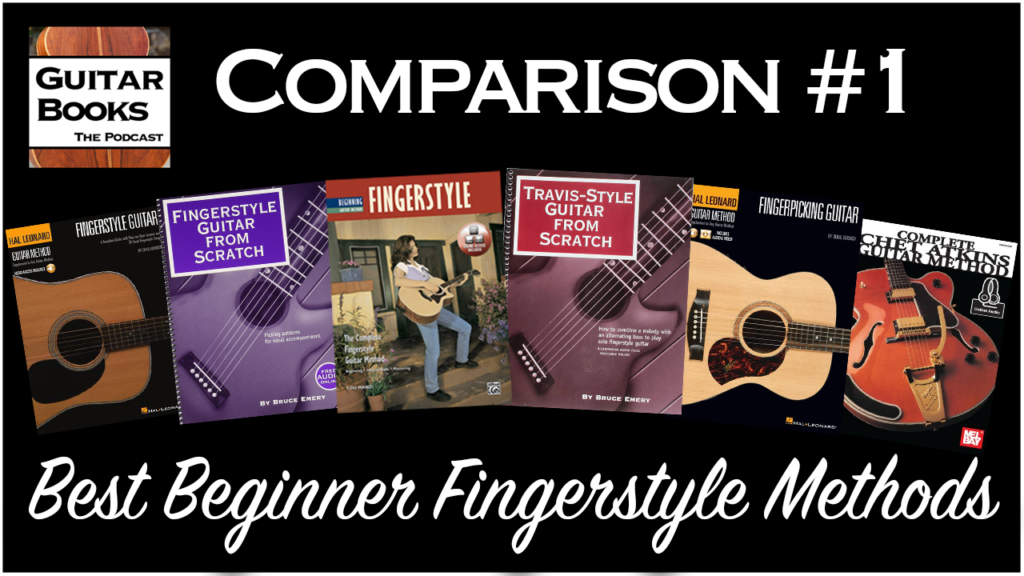
Comparison #1: Best Beginner Fingerstyle Methods

December 2, 2024 by joemcmurray Leave a Comment

https://media.blubrry.com/music_books/content.blubrry.com/music_books/Guitar_Books_Comp_1_Best_Beginner_Methods_2024_12_01.mp3

Podcast: Play in new window | Download (Duration: 18:11 — 25.1MB) | Embed

Subscribe: Apple Podcasts | RSS | More

If you want to get started playing acoustic fingerstyle guitar, you will benefit from private lessons with a teacher, online video courses, listening to fingerstyle recordings, and of course… books.  It is beneficial to mix and match all of these resources.  Remember that everyone’s brain works differently, so you may gravitate more towards certain styles of learning / methods of presentation.  I love learning from books because I can read the text at my own pace and as many times over as I want.  Seeing the music written out is extremely helpful for me – I always had more difficulty keeping track of song forms or chord progressions without some sort of written reference.

So, for those of you who want to utilize a fingerstyle guitar method book to beef up your chops, I’ve done my homework and I’ve distilled my favorites into this “greatest hits” list.  I’ll try to be objective and describe who each book is best suited to.

Best Beginner Fingerstyle Methods:

  1. Alfred’s Beginning Fingerstyle Guitar (Lou Manzi): Great all-around book to learn solo fingerstyle guitar.  Beginner to intermediate.  Not specific to any one subgenre of fingerstyle.  Nice organization/flow of information with a decent difficulty progression.  Good finger exercises to build some dexterity or to use as warmups, decent explanations in the text (but not too wordy), and nice sounding original tunes.  There aren’t any arrangements of famous tunes, but there are tunes “in the style of ___.”  I personally like working through this book with my students.  Additionally, many of this book’s lessons have sparked creative ideas of my own.  First book in a three part series, so you can continue your studies!  Audio recordings are available.
  2. Travis-Style Guitar from Scratch (Bruce Emery): This book is a gem!  This is a method book for learning to play solo fingerstyle guitar using an alternating bass (in the Travis style).  This is one of the best books I’ve found for complete beginner to intermediate players who want to learn this specific style.  Even if you want to play other sub-styles of fingerstyle as well, this isn’t a bad place to start your journey.  The material progresses logically with lots of exercises that build on each other and lead perfectly into performance pieces (old classics like Oh! Susanna, House of the Rising Sun, Jingle Bells, etc.).  Each time Emery presents a new concept, he incorporates it into updated arrangements of each tune.  Emery’s sense of humor is infused into the text of the book, keeping detailed explanations lighthearted and entertaining without losing sight of the important information.  Audio recordings are available.
  3. Fingerstyle Guitar from Scratch (Bruce Emery): I don’t love it as much as Travis-Style Guitar from Scratch, but it is still great general method book.  You will not learn to play solo fingerstyle guitar arrangements (other than a very brief introduction to the topic), but you will receive a great foundation if you are just starting out with fingerstyle.  Complete beginner to intermediate.  Emery’s sense of humor is once again infused into the text of the book, keeping detailed explanations lighthearted and entertaining without losing sight of the important information.  The book is focused on fingerstyle accompaniment using arpeggiation and Travis Style / alternating bass patterns.  This book would make an excellent primer for either Alfred’s Beginning Fingerstyle Guitar or any other fingerstyle guitar method.  Audio recordings are available.
  4. Hal Leonard’s Fingerpicking Guitar (Doug Boduch): Short and sweet method to learn to play accompaniment and solo fingerstyle guitar through famous popular tunes.  Beginner to intermediate.  Guitar teachers may find this book to be a great teaching supplement.  The progression of topics is well laid out, the examples and arrangements are playable and sound good, and the text is concise.  This book is great if you just want to play arrangements of popular tunes, but I’d recommend that you work with a teacher if you want to learn more about how to apply the information outside the book.  Audio recordings are available.  Don’t confuse this with the next book. 
  5. Hal Leonard’s Fingerstyle Guitar (Chad Johnson):  Not to be confused with the previous book, this book is a more in-depth method for learning to play both accompaniment and solo fingerstyle guitar.  Beginner to late-intermediate.  I love the chapter on arranging music for fingerstyle guitar.  There are lots of popular songs – either short samples of the accompaniment parts or full solo instrumental arrangements.  Lots of examples, although they don’t always build on each other very well, creating some tough swings in difficulty.  Audio recordings are available.  I’d recommend Alfred’s Beginning Fingerstyle Guitar over this book unless you specifically want the popular song arrangements.
  6. Mel Bay’s Complete Chet Atkins Guitar Method (Chet Atkins): Excellent method book aimed at beginner and intermediate guitar players who want to learn to play solo fingerstyle guitar arrangements in the style of Chet Atkins (the majority of which utilize an alternating bass/ Travis Style).  If you are interested in this country-blues style of playing that Chet Atkins made popular starting in the 1950s and lasting until his death in 2001, this is a great place to start.  This book ranges in difficulty from easy to intermediate, although a few of the final arrangements are fairly difficult.  This one is moves faster and gets significantly more difficult than Bruce Emery’s Travis-Style Guitar from Scratch.  I’d really recommend going through Emery’s book first and then tackling this one if you are primarily interested in solo Travis Style playing.  This book is arranged much differently from Emery’s book.  Each section focuses on playing in a new key signature, and each new key presents new challenges and new opportunities.  This book also gets you playing up the neck (but don’t be in a rush to play up the neck!).

Footer

Website by Erin Girardi

Subscribe to Podcast

Apple PodcastsAndroidby EmailRSSMore Subscribe Options

Copyright © 2026 · Atmosphere Pro on Genesis Framework · WordPress · Log in

  • Music
  • Services
  • Lessons
  • Bio
  • eBooks
  • Guitar Books the Podcast
  • Merch
  • Join the List
  • Weddings
  • Booking / Merch Order Form